

Table of Contents
Selling on Amazon in 2026 requires more than uploading a product and waiting for customers to find it. With competition across product categories, sellers need well-structured listings, relevant keywords, compelling images, competitive pricing, and a customer-focused shopping experience. This is where Amazon listing optimization becomes essential.
A properly optimized listing helps shoppers understand what a product offers, how it meets their needs, and why it may be the right choice. It can also improve the relevance of a product page for Amazon searches and support better conversion rates.
Whether you are launching a new product or improving an established catalog, a consistent optimization strategy can help you identify opportunities and make better decisions. From keyword research and product descriptions to A+ content and advertising, every element of your listing should work toward helping customers make informed purchasing decisions.
At Dizimods, we understand the importance of presenting products clearly and building a strong foundation for e-commerce growth. This ultimate 2026 guide explains how Amazon listing optimization works, which elements deserve attention, and how sellers can develop a more effective product listing strategy.
What Is Amazon Listing Optimization?
Amazon listing optimization is the process of improving a product detail page to make it more relevant to customer searches, informative, and persuasive.
An Amazon listing typically includes a product title, images, bullet points, product description, price, availability, and other category-specific information. Depending on eligibility,
sellers may also use enhanced content, such as A+ Content.
The objective is to help Amazon understand the product while giving customers the information they need to make a purchase decision.
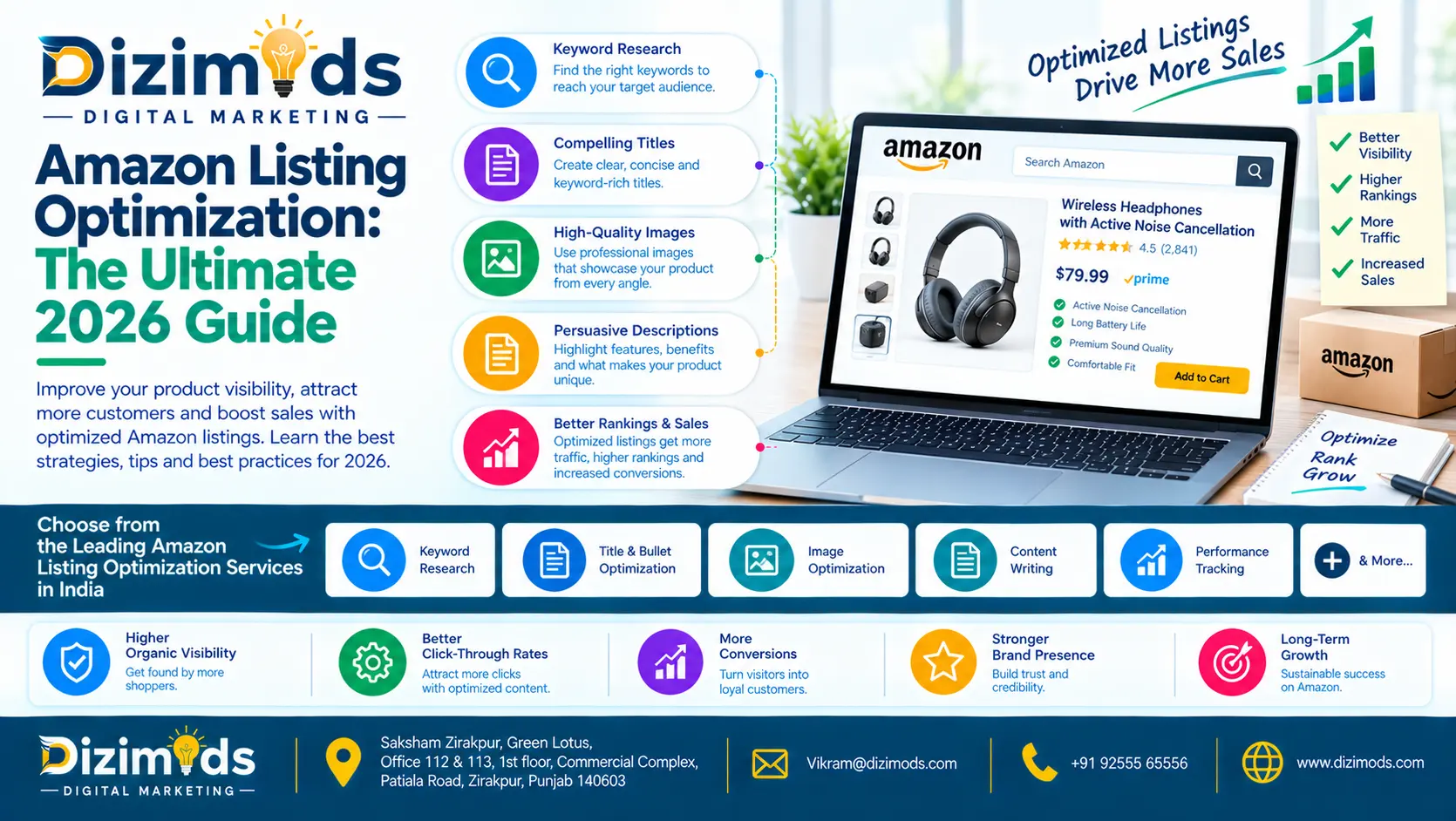
Effective optimization generally focuses on five areas:
- Search relevance: Using relevant keywords in appropriate listing fields.
- Content quality: Providing clear, accurate product information.
- Visual presentation: Using informative product images and eligible visual content.
- Conversion support: Addressing customer questions, features, and benefits.
- Continuous improvement: Reviewing performance data and updating listings when necessary.
Amazon’s requirements can vary by category, marketplace, and product type. Sellers should always verify the latest listing policies before making significant changes.
Why Amazon Listing Optimization Matters in 2026
1. Improves Product Discoverability
Customers often begin their shopping journey by searching for a specific product, feature, or solution. Relevant keywords help Amazon understand what a product page contains.
For example, a seller offering a stainless-steel water bottle might research phrases related to bottle capacity, insulation, material, and intended use. These terms should be included naturally wherever relevant rather than repeated excessively.
Keyword relevance is only one part of Amazon’s search and ranking systems. Product availability, customer experience, sales performance, and other factors may also influence visibility.
2. Helps Customers Make Informed Decisions
3. Supports Better Conversion Opportunities
4. Strengthens Brand Presentation
Consistent product titles, imagery, descriptions, and brand messaging create a more professional shopping experience.
For growing brands, maintaining these standards across an entire catalog can become difficult. A documented optimization process helps keep product information organized and consistent.
10 Essential Amazon Listing Optimization Strategies for 2026
1. Conduct Thorough Amazon Keyword Research
Keyword research is the foundation of an effective listing strategy. Start by identifying the phrases customers might use when searching for your product.
Consider:
- Primary product keywords.
- Product type and category terms.
- Important features and specifications.
- Size, material, color, and compatibility.
- Relevant use cases.
- Long-tail search phrases.
Use available Amazon search suggestions, advertising search-term reports, and suitable keyword research tools to discover relevant terms.
Separate keywords according to search intent. A shopper searching for a general product category may be exploring options, while someone searching for a specific size or feature may have a more defined requirement.
Prioritize relevance over search volume alone. Avoid including unrelated terms simply because they appear popular.
2. Create Clear and Descriptive Product Titles
The product title is one of the first elements customers notice. It should identify the product clearly and communicate its most important characteristics.
A useful title structure may include:
Brand + Product Type + Key Feature + Size or Quantity + Relevant Specification
For example:
BrandName Stainless Steel Water Bottle, Insulated, 750 ml, Leak-Resistant Lid
This is an illustrative format, not a universal template. The appropriate structure depends on the product category and Amazon’s current title requirements.
When writing titles:
- Place the most important product information early.
- Include relevant keywords naturally.
- Avoid repetitive phrases and unnecessary promotional language.
- Use accurate specifications.
- Follow the applicable category character limits and formatting rules.
A title should help customers identify the product quickly, not read like a list of search terms.
3. Optimize Bullet Points and Product Descriptions
Bullet points allow sellers to explain important product features in a scannable format. Each point should communicate a meaningful benefit or specification.
For example, instead of simply writing “750 ml capacity,” explain that the capacity may suit customers who need a bottle for commuting or everyday use, provided that this use case is accurate.
A strong bullet point can cover:
- A primary feature.
- The practical customer benefit.
- Relevant specifications.
- Compatibility or usage requirements.
- Care instructions or package contents.
The product description provides additional space to explain the product, its intended use, and other relevant details.
Avoid unsupported claims, misleading comparisons, keyword stuffing, and information that contradicts the product specifications.
4. Improve Product Images and Visual Content
Product images are important because customers use them to understand appearance, dimensions, design, and included components.
A strong image set should present the product accurately and answer common customer questions.
Consider including:
- A clear main product image that follows Amazon’s image requirements.
- Additional angles and close-up views.
- Images showing important features.
- Dimension or size information where appropriate.
- Lifestyle images that demonstrate relevant use cases.
- Infographics that explain genuine product benefits.
Ensure that images are readable on mobile devices. Avoid overcrowded layouts and small text that shoppers cannot easily understand.
Image requirements differ by category and placement, so review Amazon’s current image guidelines before uploading content.
5. Use A+ Content to Improve Product Presentation
Eligible brands may be able to use enhanced product page content through A+ Content.
Often discussed as A+ content Amazon, this feature allows qualifying sellers and vendors to present additional brand and product information through supported modules.
Depending on eligibility and available features, A+ Content may include comparison charts, product benefit sections, brand storytelling, and additional images.
To create effective content:
- Identify the main questions customers ask before purchasing.
- Organize the content into logical sections.
- Use high-quality visuals and readable text.
- Highlight meaningful features rather than repeating the same claims.
- Check how the content appears on mobile and desktop.
- Follow Amazon’s content policies and submission requirements.
Amazon Premium A+ Content may offer additional modules to eligible accounts under Amazon’s applicable conditions. Availability and requirements can change, so sellers should confirm current eligibility in Seller Central.
6. Optimize Backend Search Terms
Backend search terms can help provide additional relevant search information without adding more text to the visible listing.
Use this field strategically by identifying relevant synonyms, alternative product names, and other useful search expressions that are not already adequately represented in visible content.
Avoid repeating keywords unnecessarily, adding unrelated competitor brand names, or including misleading terms. Follow Amazon’s current byte limits and marketplace-specific instructions.
Backend keywords should complement the visible listing, not compensate for unclear product information.
7. Keep Pricing and Product Information Competitive
Pricing can influence whether a shopper chooses your product or compares alternatives.
Review your product’s price alongside its features, quality, shipping options, and competing offers. Consider your costs and margins before making changes.
Also ensure that inventory, variations, dimensions, package quantities, and other product information remain accurate.
Incorrect variations or inconsistent specifications can create a confusing shopping experience. Regular catalog checks help maintain data quality across the account.
8. Monitor Amazon Reviews and Customer Feedback
Amazon reviews can provide valuable insights into customer experiences. They may reveal recurring concerns about packaging, sizing, durability, instructions, or product expectations.
Review feedback regularly and look for patterns rather than reacting to every comment in isolation.
Use the findings to improve product information, update instructions, or investigate potential quality problems.
Amazon’s review policies must be followed. Sellers should not purchase reviews, fabricate feedback, offer incentives in exchange for positive reviews, or manipulate ratings.
9. Use Amazon Advertising Strategically
Paid advertising can help eligible sellers promote products and collect performance data. However, advertising works best when the listing is relevant, accurate, and ready to convert visitors.
An Amazon advertising agency may assist with campaign planning, keyword targeting, budget management, and performance analysis, depending on its services.
Before increasing advertising spend, review:
- Listing quality and content accuracy.
- Product availability.
- Pricing and contribution margins.
- Campaign targeting and search-term performance.
- Conversion rate and advertising cost.
- The relationship between advertising spend and total sales.
An advertising campaign cannot compensate for every listing problem. Improving the product page and reviewing campaign data together provides a more complete optimization approach.
10. Review Listing Performance and Make Regular Updates
Amazon listing optimization is an ongoing process rather than a one-time task.
Monitor the available performance metrics, such as sessions, unit session percentage, sales, advertising results, and search-term performance where those reports are available to your account.
Use the data to identify potential issues. For example, strong traffic with weak sales may indicate that the listing needs clearer product information, better images, more competitive pricing, or closer alignment with customer intent.
Change one or a small number of elements at a time where practical, and compare performance over a suitable period. Account for seasonality, inventory changes, promotions, and other factors that may affect results.
How Amazon Product Listing Services Can Help
Managing multiple product listings requires time, attention to detail, and consistent processes. Professional Amazon Product Listing Services may help businesses create, improve, and maintain product detail pages.
When evaluating providers, consider whether their services cover the areas your business actually needs.
Amazon Product Listing Optimization
Amazon Product Listing Optimization may involve keyword research, title improvements, bullet point writing, description updates, image recommendations, and backend search term research.
The goal is to make the product page more informative and relevant to shoppers.
Amazon Product Listing Management
Amazon Product Listing Management can involve ongoing catalog maintenance, product data updates, variation checks, content revisions, and listing issue resolution within the provider’s agreed scope.
This can be particularly useful for sellers managing large catalogs or frequent product changes.
Choosing an Amazon Product Listing Agency
An Amazon Product Listing Agency should understand Amazon’s content requirements, category-specific rules, and the importance of accurate product information.
Ask potential providers about their workflow, quality checks, reporting, and experience with your product category.
When comparing Amazon listing services, examine the deliverables rather than relying only on general promises about ranking or sales growth.
Dizimods can be considered as part of your research into e-commerce growth support. Confirm the availability of specific services and deliverables directly with the company before making a decision.
How Amazon Account Management and SEO Fit Into the Strategy
For some sellers, listing optimization is part of a wider operational and marketing plan.
Amazon account management services may include catalog maintenance, account health monitoring, listing updates, reporting, and other marketplace support, depending on the provider.
Similarly, Amazon SEO services may focus on keyword research, listing relevance, and improving product content in line with Amazon’s requirements.
These services should complement one another. A seller may have well-optimized listings but still face challenges involving stock availability, pricing, product quality, or advertising efficiency.
Before hiring a provider, clarify which responsibilities it will manage and which will remain with your internal team.
Understanding Amazon Vine and Product Reviews
Amazon Vine is a program through which eligible reviewers can receive products to evaluate and provide honest, independent reviews. It can help participating brands obtain product feedback under the program’s applicable requirements.
Sellers researching Amazon Vine, the Amazon Vine program, or the Amazon Vine Voice program should check Amazon’s official resources for current enrollment rules, product eligibility, fees, and marketplace availability.
Searches for the Amazon Vine program India and Amazon Vine India should be verified against current official information, as regional availability and program conditions may change.
If you need to access program information, use official Amazon seller resources rather than unfamiliar third-party websites requesting account credentials. A search for Amazon Vine login should lead you to a legitimate Amazon destination.
Participation in Vine does not guarantee positive reviews or a particular number of reviews. Sellers must not attempt to influence reviewers’ opinions or condition participation on positive feedback.
A strong listing remains important regardless of review collection methods. Accurate descriptions and clear images help customers understand the product before purchasing.
Common Amazon Listing Optimization Mistakes to Avoid
Even experienced sellers can make mistakes that reduce listing quality or create compliance problems.
Keyword stuffing: Repeating the same phrase excessively makes content difficult to read and may violate listing requirements.
Misleading claims: Unsupported performance, health, safety, or comparative claims can damage customer trust and create policy issues.
Poor-quality images: Blurry images, unclear dimensions, and missing product angles leave shoppers with unanswered questions.
Ignoring customer feedback: Repeated complaints may reveal product or information problems that need attention.
Overlooking mobile presentation: Long paragraphs, small image text, and cluttered layouts can make listings harder to navigate on smaller screens.
Making frequent changes without analysis: Unstructured edits make it difficult to determine which changes contributed to performance differences.
Ignoring category rules: Titles, images, variations, and other listing fields may have category-specific requirements.
Avoiding these mistakes creates a more reliable foundation for ongoing improvement.
Frequently Asked Questions (FAQs)
Conclusion
Amazon listing optimization is an essential part of building a competitive marketplace presence in 2026. Relevant keywords, accurate product information, clear images, compelling descriptions, and regular performance reviews help create a better shopping experience.
Sellers should approach optimization as an ongoing process. Monitor customer feedback, investigate performance changes, follow Amazon’s policies, and make evidence-based updates instead of relying on keyword stuffing or unrealistic ranking promises.
For businesses that need additional support, Amazon Product Listing Services, Amazon Product Listing Management, and related marketplace solutions may help streamline catalog operations and improve content quality.
Dizimods encourages sellers to prioritize accurate information, customer trust, and sustainable growth. By combining thoughtful listing optimization with consistent account management and responsible marketing, businesses can build a stronger foundation for long-term success on Amazon.
Result-Driven SEO Agency Backed by Experience
Built for brands that want long-term growth – not shortcuts.