

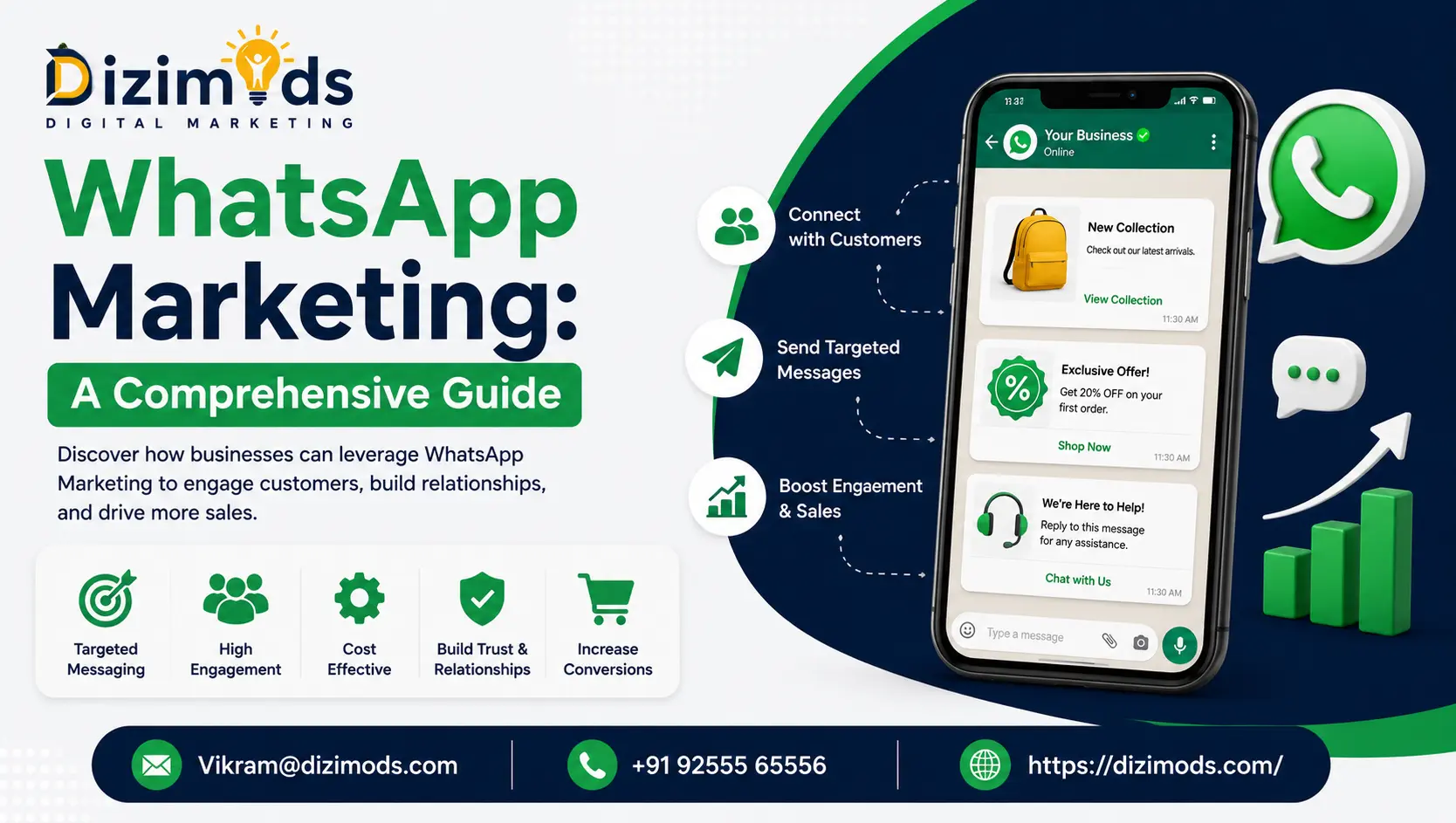
WhatsApp is one of the most effective digital marketing channels, helping businesses connect directly with customers for marketing, sales and support. However, using WhatsApp alone is not enough for a successful omnichannel strategy.
In this article, Dizimods explains what WhatsApp marketing services are, why they matter, their key benefits and how integrating WhatsApp with your existing marketing channels can help improve customer engagement and business growth.
What is WhatsApp Business?
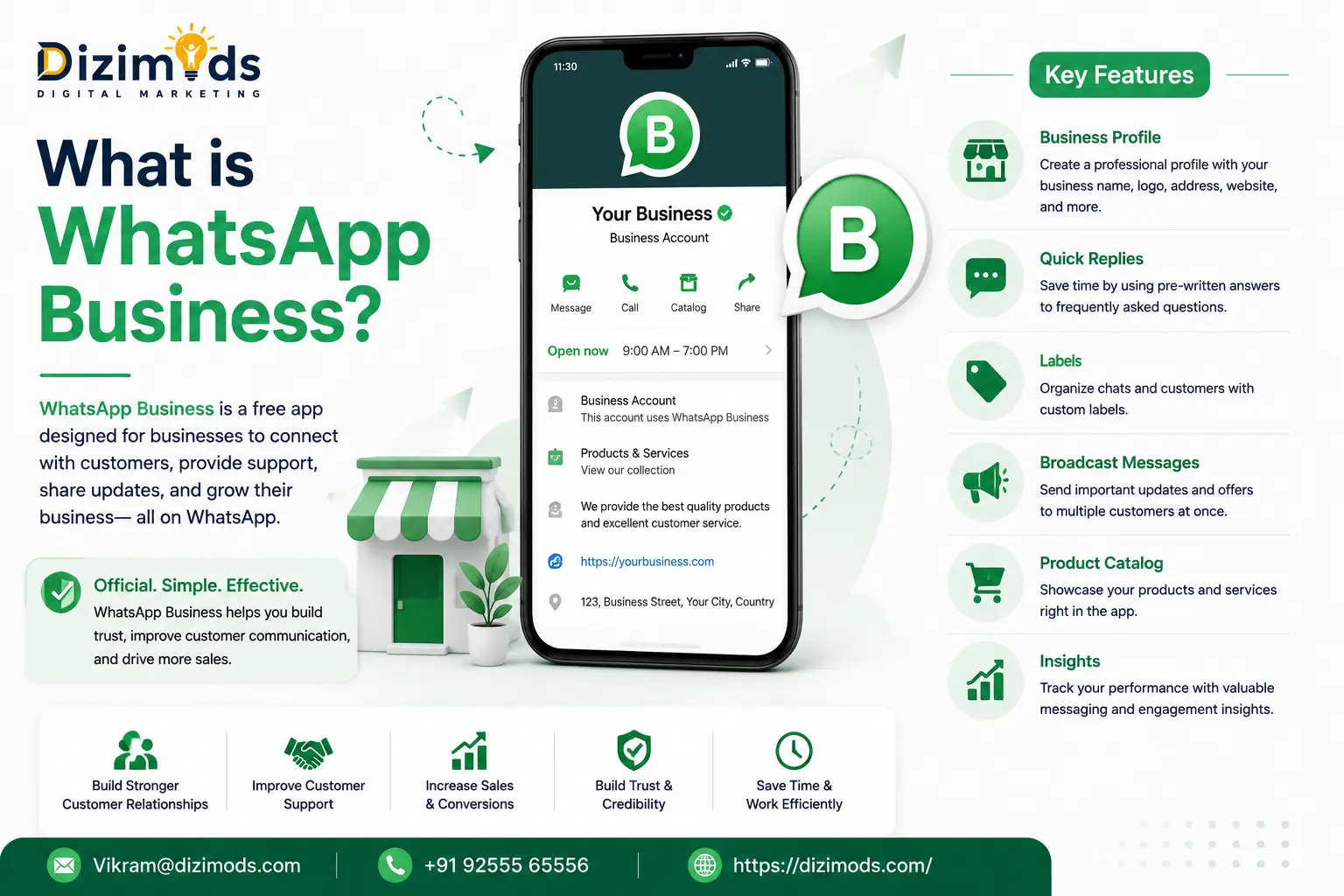
Launched in 2009, WhatsApp started as a simple messaging app and quickly became one of the world’s most popular communication platforms. Following its acquisition by Meta in 2014, WhatsApp introduced new features and expanded its business capabilities with the launch of WhatsApp Business in 2018.
Today, businesses use WhatsApp for real-time customer support, product promotions, customer engagement, supplier communication and sales conversions. When combined with SEO services, local SEO and e-commerce SEO services, WhatsApp becomes a powerful tool for driving visibility, customer acquisition and business growth.
WhatsApp Business features
WhatsApp Business launched with a similar interface to the regular version and features that improved business interaction management. These are some of the app’s main features:
Business Profile
When registering an account, the company can add a brief description and details such as segment, address, opening hours, website and primary email.
Automatic Messages
Catalog
Conversation markers
Broadcast lists
Metrics
WhatsApp Business API
WhatsApp for Business has brought benefits to small, medium and large businesses. Small businesses can build direct and personalized customer relationships, while larger organizations benefit from the platform’s massive reach and engagement potential.
For enterprises managing thousands of customer interactions, integrating WhatsApp with digital marketing, AI SEO services and technical SEO services can help streamline communication, improve customer experiences and support scalable business growth.
Above All: How can we meet such a large demand without compromising personalized service?
The WhatsApp Business API was the solution launched to address these issues. The API provides large-scale customer service by connecting the app to other digital marketing technologies, such as chatbots, social media and software like CRM and CDP.
In addition to automating processes and facilitating handovers to human agents, the API enhances WhatsApp campaign creation by retrieving data from other systems. It also grants a verification seal to linked accounts, reinforcing brand credibility.
What is WhatsApp marketing?

WhatsApp marketing is the strategic use of WhatsApp to promote products, services and brand messages while building stronger customer relationships. It goes beyond simply sending promotional messages and is a key part of effective WhatsApp marketing services.
For the best results, WhatsApp should be integrated into your overall marketing strategy alongside content strategy services, sales campaigns and customer engagement initiatives. When used correctly, it becomes a powerful channel for driving conversions, customer loyalty and long-term business growth.
Why invest in WhatsApp marketing?
Benefits of WhatsApp for your strategy
You can see that WhatsApp without a strategy is more of a hindrance than a help, right? However, a digital marketing strategy without WhatsApp is also incomplete. This is because the app can be a leading or supporting player in an operation — it all depends on your goals.
It’s important to understand the benefits of WhatsApp to determine what role the app can play for you. This role can be achieved throughout the entire purchasing journey, as long as communication is customer-centric.
High message delivery and open rates
Compared with email marketing, WhatsApp delivers significantly higher message delivery and open rates because most users access the app daily. These advantages make it a powerful channel for time-sensitive campaigns, customer engagement and conversion rate optimization services.
If recipients enable read receipts, businesses can also track message views, making WhatsApp ideal for flash sale announcements, abandoned cart reminders and other high-converting campaigns. When combined with social media marketing services, WhatsApp can help brands reach customers more effectively and drive better marketing results.
Comfort in use
After viewing the message, users can respond at their own pace and through a channel they already use (even more than their phone). Besides giving customers a certain level of autonomy, communicating via WhatsApp is natural, which increases the chances of feedback.
For companies, the ease of creating and converting a business account also plays a role in choosing the app.
Universal platform
With a simple and intuitive interface, WhatsApp has managed to bring together audiences of virtually all ages. To date, no other tool or social network has achieved such a broad reach in such a short time—a very important factor for brands investing in “numbers games” (campaigns that prioritize sales volume or market share).
Furthermore, the app’s evolution hasn’t made it more difficult to manage. With a predefined strategy, operating the app itself doesn’t require as much marketing and technology knowledge.
Viral potential
Direct and informal communication
Forget long minutes on the phone and days (or even weeks) waiting for an email. Just like you, customers want quick responses and simple solutions via WhatsApp.
This is the ideal way to streamline communication and speed up the sales cycle, using marketing automation to streamline tasks. Agility also encourages a more relaxed human exchange, enhanced by the use of emojis, GIFs and stickers (within the bounds of professionalism, of course).
Cost-benefit ratio
WhatsApp’s free nature was one of its biggest attractions for the population compared with traditional text messages (SMS/MMS) and call centers.
It’s important to note that integrating the app into an omnichannel strategy requires contracting services such as CRM software and a WhatsApp Business API provider. Even so, using the app is free and offers a significant financial return.
How to Market on WhatsApp: A Step-by-Step Guide

WhatsApp marketing is one of the most effective ways to connect with customers, generate leads and increase conversions. When combined with SEO Services, local SEO and e-commerce SEO services, AI SEO services and technical SEO services become a powerful channel for driving business growth.
1. Segment Your Audience
Successful WhatsApp marketing starts with understanding your audience. Segment customers based on their interests, behavior, purchase history and stage in the customer journey. Audience segmentation helps businesses send relevant messages that improve engagement and conversion rates.
2. Plan Your Campaigns
Create a communication strategy that aligns with customer expectations and business goals. Integrating WhatsApp with SEO services, email marketing, social media and website campaigns can significantly improve campaign performance and customer engagement.
3. Automate Customer Communication
Automation helps businesses deliver timely responses while maintaining personalization. Features such as welcome messages, order updates, appointment reminders and product restock alerts improve customer experiences and operational efficiency.
4. Connect Marketing, Sales and Support
WhatsApp can support the entire customer journey, from lead generation to customer retention. Businesses can use it for lead nurturing, sales follow-ups, customer support, feedback collection and loyalty campaigns. Combining WhatsApp with local SEO and e-commerce SEO services can further strengthen customer acquisition and retention efforts.
5. Monitor Performance and Optimize
Track key metrics such as open rates, response rates, click-through rates, conversions and customer engagement. By combining WhatsApp insights with AI SEO services and technical SEO services, businesses can make data-driven decisions and continuously improve marketing performance.
The Future of WhatsApp Marketing

WhatsApp continues to evolve with new features that help businesses build stronger customer relationships. Brands that combine personalization, automation, brand strategy and omnichannel marketing will be better positioned to drive engagement, improve conversions and achieve long-term growth.
At Dizimods, we help businesses integrate WhatsApp into a complete digital marketing ecosystem through effective PPC management services, customer engagement strategies and seamless experiences across every touchpoint.
WhatsApp marketing FAQs
Dizimods helps businesses create and manage effective WhatsApp marketing strategies, including audience segmentation, campaign automation, CRM integration, customer engagement and performance tracking to maximize results and business growth.
Result-Driven SEO Agency Backed by Experience
Built for brands that want long-term growth – not shortcuts.