Managing social media has become the most important task for brands, and for good reason. Between the way algorithms frequently change, how high the expectations for engagement are, and the likelihood that your team is switching between dozens of social media management platforms, trying to tie both engagement and advertising into a return on investment, it is understandable that your team is confused about how advances in artificial intelligence are going to influence social media management.
By 2026, the situation has become even more extreme. With more than 5.41 billion people around the world using social media, brands risk being left behind if they do not have an established social media management system. Social media has become the most frequently used tool for direct brand engagement, and customers today want to purchase from brands that they have an established relationship with on social media, which is why brands have to prioritize social media more than ever.
The aim of this document is to make social media management simple by explaining the pillars, the management system, the tools, and the challenges to brand strategy.
What is social media management?
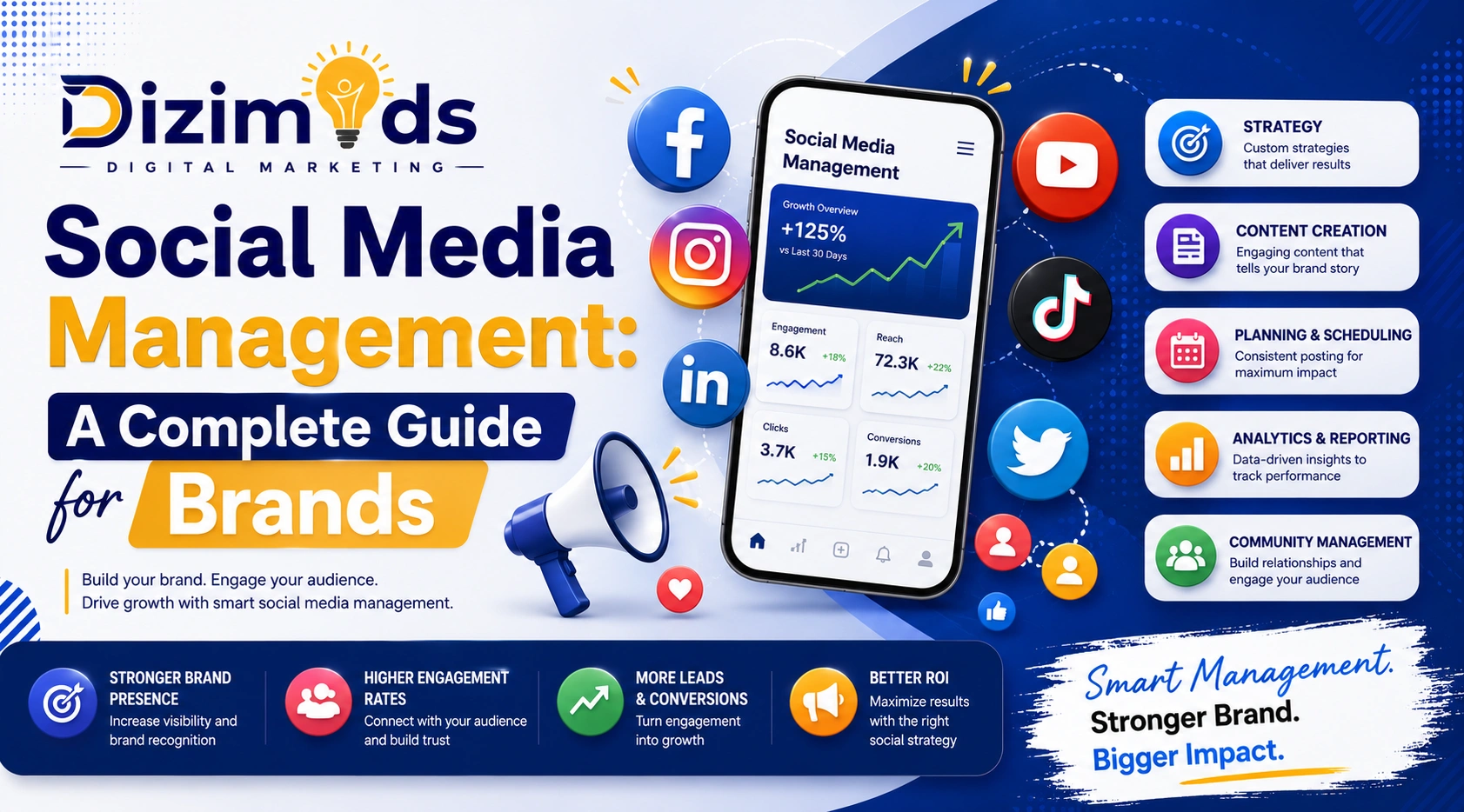
Managing social media refers to managing a brand’s social media presence across all platforms. This includes posting content, scheduling, messaging users, and analyzing metrics. The purpose is to create a strategy that has a positive brand-related business impact and to develop and strengthen relationships and brand awareness across platforms.
Social media management vs social media marketing
Social media marketing and social media management are often conflated but refer to distinct roles that are complementary.
Social media marketing encompasses the entire strategy — what are the goals, who is the target audience, what are the campaigns, and what content builds awareness, engagement, and conversion? Social media marketing is focused on the why and who: Why are we using social media, and who are we attempting to reach?
Social media management refers to the actual handling of the social media channels and the execution of the social media marketing strategy. This includes the management of the day-to-day activities of social media, such as the scheduling of content, the monitoring of engagement on the various social media platforms, audience engagement, and the measurement and analysis of results.
Marketing defines the goals of the organization, while management executes the goals.
The strategy and management are dependent on one another. The right marketing strategy affects social media management activities. In tandem, social media marketing and management create a framework that utilizes social media to its fullest potential to drive growth in the organization.
Read More Blog: Top 10 Web Development Companies in India
Key Skills of a Social Media Manager

A variety of skills and responsibilities go into being a social media manager that extend far beyond simple post scheduling and engagement. From crafting catchy captions and graphics to response and reputation management, social media managers do it all and then some.
Here are a few examples of core responsibilities and skills of a social media manager:
- Crafting and curating social content that is on brand and engaging in every format.
- Engaging with the social community and/or target audience based on posts to build a positive reputation for the brand.
- Analyzing engagement, reach, and conversion statistics to adapt strategies accordingly.
- Knowing the industry and brand enough to listen socially and spot trends.
- Managing paid social ads to hit the target audience.
- Understanding the goals of the business enough to strategically plan social media strategies that correlate.
- Being an expert and informed on the best practices of various social platforms.
- Being prepared for a social media crisis involving negative feedback and managing an upset reputation of a brand.
- Knowing social media and the evolving practices of ranking SEO.
- Being knowledgeable on social media automation and AI technologies.
Finally, the important skill of being adaptable is being able to change practices when audience preferences change.
Read More Blog: Best Social Media Marketing Agency For Leads, Growth & Results
Benefits of social media management

Just having social media accounts isn’t the whole package; how you utilize them properly defines your brand. Many accounts that are poorly managed miss many engagement opportunities. In contrast, accounts that are properly strategized and managed have a lot of real-world impacts.
Here is why this strategy is a must in 2026:
- Your time and strategy matter: Social media is the fastest-moving industry to exist. Having poor management of posts and comments means you could be wasting time and watching your brand become irrelevant. Strategizing your social media management means you won’t have to think about it at the last minute.
- Real-time management: Social media is the fastest way to reach your customers. All engagement is timely and important. Managing your accounts means you’re actively monitoring to prevent concerns and represent your brand.
- Your posts need purpose: Many things can be said about the clicks and interactions on posts. Having poor management means you miss your insights. With purpose and management of your posts, you can evaluate what is and what isn’t working and save on budgeting.
- A good management strategy is important for your brand: Having to manage many social media accounts is time-consuming and becomes detrimental to productivity If you have an automated system to support your strategy, the management of your accounts is maximized, and you focus more on the real strategy and less on management.
- From presence to performance: Just being on social media is no longer enough; it is now about the social media performance. Good social media management means posts, comments, and activities relate to business goals, e.g., lead generation, sales, and brand awareness, and not just being active.
Read More Blog: Digital Marketing in 2026: New Strategies with Dizimods
5 core pillars of social media management
A business social media management agency drives results through multiple coordinating activities. The five pillars to get it right are:
1. Content creation and curation
- What it is: High-quality and engaging content comes in multiple formats and can even be users’ posts.
- Why it matters: Content helps build a story and is the presence social media lacks.
- Action tip: Different formats solve different challenges. Use the format your audience wants to consume.
2. Scheduling and publishing
- What it is: Putting content out at the right time for it to be seen and engaging.
- Why it matters: Content needs to be seen to be useful. Consistent engagement keeps the brand relevant.
- Action tip: An automated publishing system can be used to consistently engage; however, analytics should be used to determine when the optimal time to post is.
3. Community management
- What it is: Community management occurs when a brand responds to engagement.
- Why it matters: A brand that manages its community builds trust and loyalty.
- Action tip: Timeliness and authenticity matter. Reputation challenges turn into the great strength of the brand.
4. Social listening and monitoring
- What it is: Social listening tracks the perception and mentions of the brand. Monitoring looks for opportunities to engage.
- Why it matters: Social listening and monitoring looks for engagement opportunities. Social media challenges make it harder to manage a brand’s reputation and help you find more opportunities even after you think there are none.
- Action Tip: Establish alerts to note every time your brand is mentioned, and utilize this information to improve your plan or strategy.
5. Analytics and Reporting
What it is: Success is measured by performance metrics such as engagement rate, click-through rate, and, of course, return on investment (ROI).
Why it matters: Knowing and tracking social media metrics will help you design more effective content; fine-tune your strategy; and utilize more effective tactics in your marketing.
Action Tip: Frequently analyze performance documentation to determine the optimal areas of your strategy and the factors requiring the greatest effort or investment.
Read More Blog: Magnetic Marketing Strategies for Explosive Sales 2026
Tools for overall social media management

Though it can be done, it is not efficient to manage social media manually. By 2026, brands that use the right tools will create streamlined operations for their social media, increasing productivity and positive outcomes.
Social media management tools
Dizimods Social – Great for large companies that need to manage all their channels in one place.
Hootsuite – Best for scheduling posts and collaborating with your team.
Agorapulse – Best for social inboxes and engagement.
Content creation tools
Canva – Simplifies making graphics and images.
Adobe Express – Social media editing images, videos, and animations made easy.
CapCut – AI to edit and create short videos.
Narrato AI Content Genie – Content automation for social media, creating posts for the week on given themes or URLs.
Monitoring & social listening tools
Dizimods Insights – Real-time sentiment analysis, trend prediction, and competitive intelligence with millions of conversations, all through the power of enterprise AI.
Brandwatch – Tracks sentiment and trends with AI.
Talkwalker – Social listening and analytics impacted by AI.
Analytics & reporting tools
Google Analytics – Tracks Clicks and Visits.
Dizimods – Social media performance and metrics made easy with simplified reporting and dashboards.
Quintly – Synaptic benchmarking for tracking social media competitors.
Scheduling & Publishing Tools
Meta Business Suite – Facebook and Instagram have their native tools for importing and scheduling ads through Meta Business Suite.
Dizimods Social – Works with brands to develop automated, safe, and compliant workflows for content posting and scheduling across various channels with built-in analytics.
Later – Works best with Instagram, TikTok, and Pinterest.
Team Collaboration Tools
- Slack – Communication for social teams
- Asana – Used to build and manage social teams’ content calendars and other workflows.
- Trello – Task management tool focused on a visual board useful for planning and executing marketing campaigns.
Implementing these tools leads to faster processes, greater productivity, and improved decisions. Automated scheduling, messaging, insights, and collaboration drive productivity. The proper tools redefine social media and create a measurable competitive advantage for your business.
Read More Blog: Top SEO Companies In India That Actually Deliver Results
How to grow your social media engagement?

Want to turn passive followers into active participants? Here’s how to spark real social media engagement:
✔️ Talk with your audience, not at them: Respond to comments, ask questions and join conversations — make it two-way dialogue
✔️ Post consistently, not constantly: Maintain a steady rhythm (quality over quantity) using a content calendar
✔️ Leverage trends strategically: Jump on relevant viral moments, but only if they align with your brand voice
✔️ Use video to stop the scroll: Short-form video (Reels, TikTok) drives 2-8 times more engagement than static posts
✔️ Run targeted engagement campaigns: Polls, Q&As, live sessions, stories with engagement stickers and user-generated content prompts keep audiences involved
✔️ Collaborate with influencers and partners: Cross-promotions and partnerships expand reach and drive credibility
✔️ Analyze and iterate: Double down on what works. If carousels perform best, create more of them
Engagement isn’t vanity metrics — it’s the pulse of your community. Measure replies, saves and shares, not just likes.
Read More Blog: Best GMB Review Services in India
Latest trends in social media management

By 2026, we expect social media to be moving at breakneck speed. This means that new trends will emerge rapidly, and the brands that best predict and adapt to them will be the best on the market.
Here’s how to stay ahead of the market when it comes to social media this year:
Leveraging AI
While AI does most of the busy work now, the best social media strategies will be the ones that use AI as a creative tool. This will mean that social media managers will refine and train the AI they work with.
Pro Move: Use ChatGPT-5o to predict engagement and Synthesia to send large-scale personalized video responses. Remember that these should be used to aid social media work, so ensure that you are adding a personal touch to everything you post.
Centralized Command Centers
The best way to reduce the chaos that comes with managing social media across many platforms is to manage it all from one. More brands are using integrated social media tools.
Pro Move: Set up workflows within Dizimods to allow effortless engagement, approvals, and alerts across the whole organization.
3. Trust and Privacy = Social Media Success
There are going to be regulations on social media that demand greater accountability from brands. If you are not managing your social media well, expect to face severe consequences. Brands will be forced to implement strict measures that control who posts what and when.
Pro Move: Using governance tools is a smart option when you want to control who is allowed to post or respond and who is allowed to view sensitive data to avoid data breaches. You can protect your brand by setting up automated processes to approve posting requests and ensure they are compliant with brand and legal requirements.
Frequently Asked Questions (FAQs)
Consider hiring if:
- Social media directly impacts revenue
- Engagement and content demands exceed your capacity
- Strategy requires specialized expertise (ads, analytics, etc.)
For small businesses, starting with tools + limited hours can work.
✖️ Ignoring engagement – Responding builds trust
✖️ No strategy – Random posting leads to low ROI
✖️ Focusing on vanity metrics – Conversions matter more
✖️ Not optimizing for platforms – Content should be tailored
✖️ Over-automating – Keep a human touch
AI-driven tools now assist with content, engagement and insights. Social search optimization (SSO) is rising, private communities are growing, and short-form video dominates.
Result-Driven SEO Agency Backed by Experience
Built for brands that want long-term growth – not shortcuts.