

Simply put, Technical SEO focuses on the website’s framework and server elements that shape search engine results and rankings. You’re probably familiar with search engine optimization. It’s the use of strategically worded phrases to catch the attention of searching bots, like Google. Technical SEO, on the other hand, optimizes server and code aspects for the SEO of an entire site. For example, it optimizes the time it takes for a site to load.
What’s Technical SEO?
To improve a website’s ranking on Search Engine Result Pages (SERPs), technical SEO optimizes the website’s server and code elements. On-page or off-page SEO targets site content and links that connect to other sites. Technical SEO focuses on the framework or elements that shape how search engines read, organize and rank a site. Technical SEO, therefore, aims to improve a site’s rank to enhance how search engines read and rank the site.
Key Components of Technical SEO
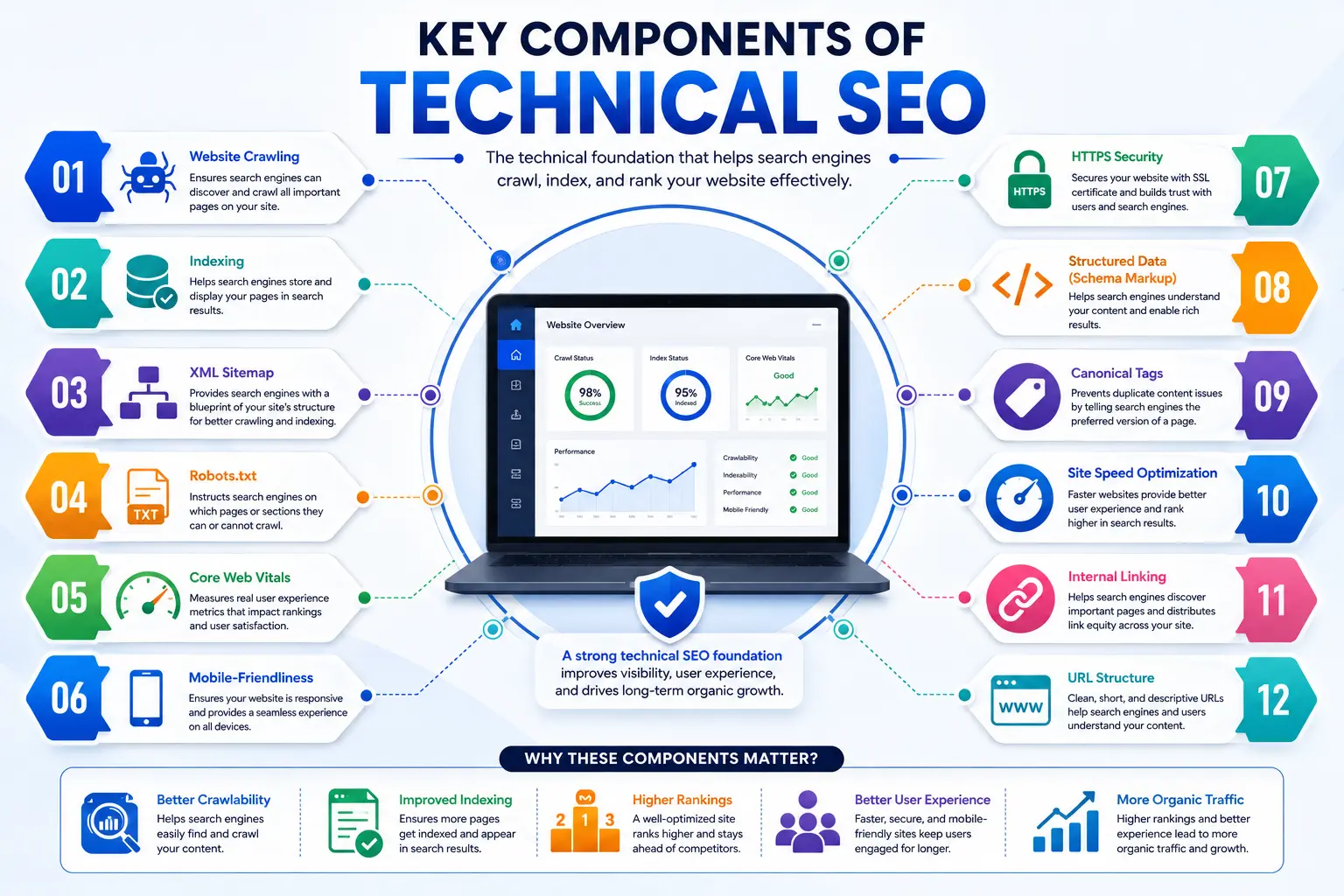
Here are some key components of technical SEO that are as follows:
1. Crawlability
Crawlability is foundational in technical SEO. This allows search engines to discover and index your website. If your website is designed structurally and hierarchically well with optimized navigations, then search engines can navigate through your website easily. Identifying relevance to a search query is done by search engines through your website. The following are some of the factors associated with crawlability through technical SEO services.
- XML Sitemaps: Websites online contain a lot of URLs. Their information is also found in a document called an XML sitemap with more information such as how and when they were last modified. By submitting a sitemap, search engines are able to discover pages more efficiently.
- Website Structure: The architecture of your website has a huge impact on crawlability and how search engine crawlers navigate and understand your website. If your website is designed well and organized logically, it enhances crawlability and allows search engines to index your website more effectively.
2. Indexing
After crawlability, your site needs to be indexed to appear in search results. Indexing is the process search engines store and organize your site’s content in their database. Proper indexing is necessary to ensure your site appears when users search with relevant keywords. Important aspects of indexing include the following:
- Robot.txt: Created by the site’s designer, this file prevents search engines and bots from crawling their site. It has a list of allowed and disallowed sites and when a bot tries to access a site, it checks the robots.txt file and accesses only those sites that are allowed. It doesn’t show disallowed sites in the search results.
- Canonicalization: These tags inform search engines which is the preferred version of a page if multiple pages with similar content exist.
- Mobile-Friendliness: It is now expected that businesses maintain a mobile-friendly site; there is no longer an option to have or not to have one. Search engines will index sites that offer a good customer experience on mobile. A good way to do this is to ensure search engines can easily view and read your content on a mobile site. Being mobile-friendly can be accomplished through the use of responsive design or creating a mobile site.
Read More Blog: Best SEO Company in Zirakpur
3. Content Quality
A technical SEO company deals with the back end of your site, but content quality is always important. Search engines look for websites that provide quality content. This content should always be informative and relevant. Most importantly, it should help answer the users’ search queries. Making quality content that your target audience wants is the best way to increase your website’s ranking and help grow your audience.
4. Page Speed
Technical SEO includes page speed. This is no surprise, because slow-loading websites leave a poor impression on users and search engines. Poor page speed also affects your conversion rate. To speed up your website, consider using a CDN or allowing users to cache content. You can also decrease your page speed by reducing the size of your CSS and JavaScript files.
5. Structured Data
Structured data is also called schema markup. This backend feature helps your website stand out more on a search engine result page and helps display rich snippets. Structured data leads to search engines displaying more detailed content. This might be more specific content about your website that is a review or more detailed content about your event or product. Adding this to your website helps search engines provide detailed results. This may also increase your website’s relevancy and engagement rate.
6. Internal Linking
In technical SEO, internal linking helps outline your website’s structure. Internal links help search engines recognize the connection between your site’s pages and how to rank them. Internal links also help improve usability. The best way to achieve this is to link relevant pages. This helps users recognize the information you are trying to help them find.
7. Redirects & Canonicalization
In order to help your rankings, managing redirects and canonicalization helps mitigate duplicate content. Redirects are the way you send users and search engines to one destination and canonicalization is the way you help search engines choose which page to index when you have multiple pages. When you have this in place, search engines will be able to find the version you want the content strategy to be and therefore mitigate the risk of duplicate content.
8. Security (HTTPS)
The security of your site helps the trust of your users and your site’s rankings. Adding HTTPS, encrypting your site and adding protections against breaches help keep your site safe. A secure site helps improve your rankings and your reputation. It protects your site from external threats.
9. Ongoing Monitoring and Maintenance
Technical SEO makes your site compatible with search engines and involves continuous monitoring and maintenance. Regular checks and swift responses to the performance of your site help to resolve issues pertaining to technical SEO. An understanding of the new trends and practices in the industry is also required.
10. Broken Links
A broken link is a hyperlink that no longer functions. Instead of showing a resource or webpage, clicking a hyperlink that’s broken leads to error messages that are usually “404 Not Found.” Broken links are the result of missing content, changes to a URL, server issues, typing errors and several other issues. Navigation through the site is made difficult with the presence of broken links. To preserve the structure of the website and a positive user experience, broken links should be fixed. The presence of broken links impacts the ranking of the site due to search engines factoring them in as an indicator of the site’s relevance and health.
Read More Blog: SEO Company in Chandigarh
What is the importance of technical SEO?

Technical SEO matters for the numerous benefits it provides to a site’s visibility and success in search engines. Below are the advantages of technical SEO.
1. Improved Crawling and Indexing
With the right technical SEO, search engine bots will have an easy time crawling and indexing the site. Consequently, this will help search engines understand the relevance and structure of a website and its pages.
2. Improved User Experience
Page speed and responsiveness are two technical SEO elements that greatly influence user experience. A good user experience generates low bounce rates and high engagement. These metrics are positive signals to search engines.
3. Higher Rankings
Technical SEO influences search engine algorithms when determining where to rank websites. A site that incorporates technical SEO is more likely to appear higher in search results. This correlates with more traffic.
4. Less Duplicate Content
A major aspect of technical SEO is canonicalization. This solves the problem of duplicate content. Search engines prefer content that is unique and that avoids duplication.
5. Structured Data and Rich Snippets
Data that is structured or marked with schema can alter search results to be more informative or descriptive. This can create a rich snippet and improve the click-through rate.
6. Website Security
Using an HTTPS framework protects users and their data. Search engines view this as a positive ranking factor. A security framework makes a site more trustworthy.
7. User-Friendly URL Structure:
A descriptive URL helps users understand page content. This is appreciated by users and search engines alike. This leads to better rankings and a positive user experience.
8. Easy Site Navigation
When site structure and navigation are easy to understand, it improves user experience and helps search engines understand how the site’s pages relate to one another. Because of this, it is possible to be ranked better for certain keywords.
9. Algorithm Flexibility
Search engines change the algorithms they use to rank sites. Good technical SEO means a site is able to accommodate these changes. Sites with good technical SEO will change with the algorithms and will keep their ranking or even improve them.
10. Advantage over Rivals
If a Dizimods company invests in the technical SEO of its site, it has the opportunity to gain a lot. An optimized site attracts and retains users. This is compared to the sites of rivals that do not employ even the basic technical SEO.
Read More Blog: SEO Company in Mohali
Benefits Of Technical SEO

There are quite a few benefits of investing in technical SEO. Here are some:
1. Visibility
The primary benefit of technical SEO is improving search engine visibility. This is because technical SEO makes it easier for search engines to crawl and index content.
2. Better Rankings
A properly structured and quick site that is also mobile responsive is situated to capture higher rankings and, as a result, more relevant, organic traffic.
3. Better Experience
Optimization of responsiveness and loading speeds improves the user experience and as mentioned previously, this drives down bounce rate.
4. Fewer Issues Related to Duplicate Content
To solve search engine duplicate content issues, canonicalization and some of the other technical SEOs ensure that search engines index and rank the preferred page.
5. Increased Click-Through Rates (CTRs)
Well-implemented technical SEO leads to rich snippets and structured data. Results appear more engaging, result in higher CTRs and facilitate users in navigating through their searches.
6. Safe Sites
When SSL certificates are implemented to facilitate HTTPS, user data is now safe and the improved site security is positively perceived by search engines, thus improving ranks. Safe sites are more likely to be used.
7. Flexibility to Algorithm Modifications
Technical SEO proves to be beneficial when search engine algorithm modifications are addressed. Flexibility is essential for improving ranks.
8. Advantage
Sites that are technically optimized are more likely to be used than unoptimized sites.
9. Page Load Speed
SEO technicians optimize page load speed. Low bounce rates and enhanced site security are perceived positively and improve user experience.
10. Indexing and Crawling Works Well
Technical SEO proves valuable when content needs to be indexed quickly. Search engine bots have less crawling work to do.
11. Better Conversion Rates
When users have a positive experience with a fast site and especially one that is optimized, they are more likely to convert.
12. Improved Analytic Insights
With technical SEO, analytics tracking is set up correctly, giving insights into user behavior and website performance.
Conclusion
Including a technical SEO checklist is always important for any digital advertising strategy. Brand strategy and business owners should prioritize their website’s technical SEO, as the payoffs outshine the preliminary pains in grasping the theories and employing the strategies. However, if done right, you can forget about it for a very long time.
Result-Driven SEO Agency Backed by Experience
Built for brands that want long-term growth – not shortcuts.