

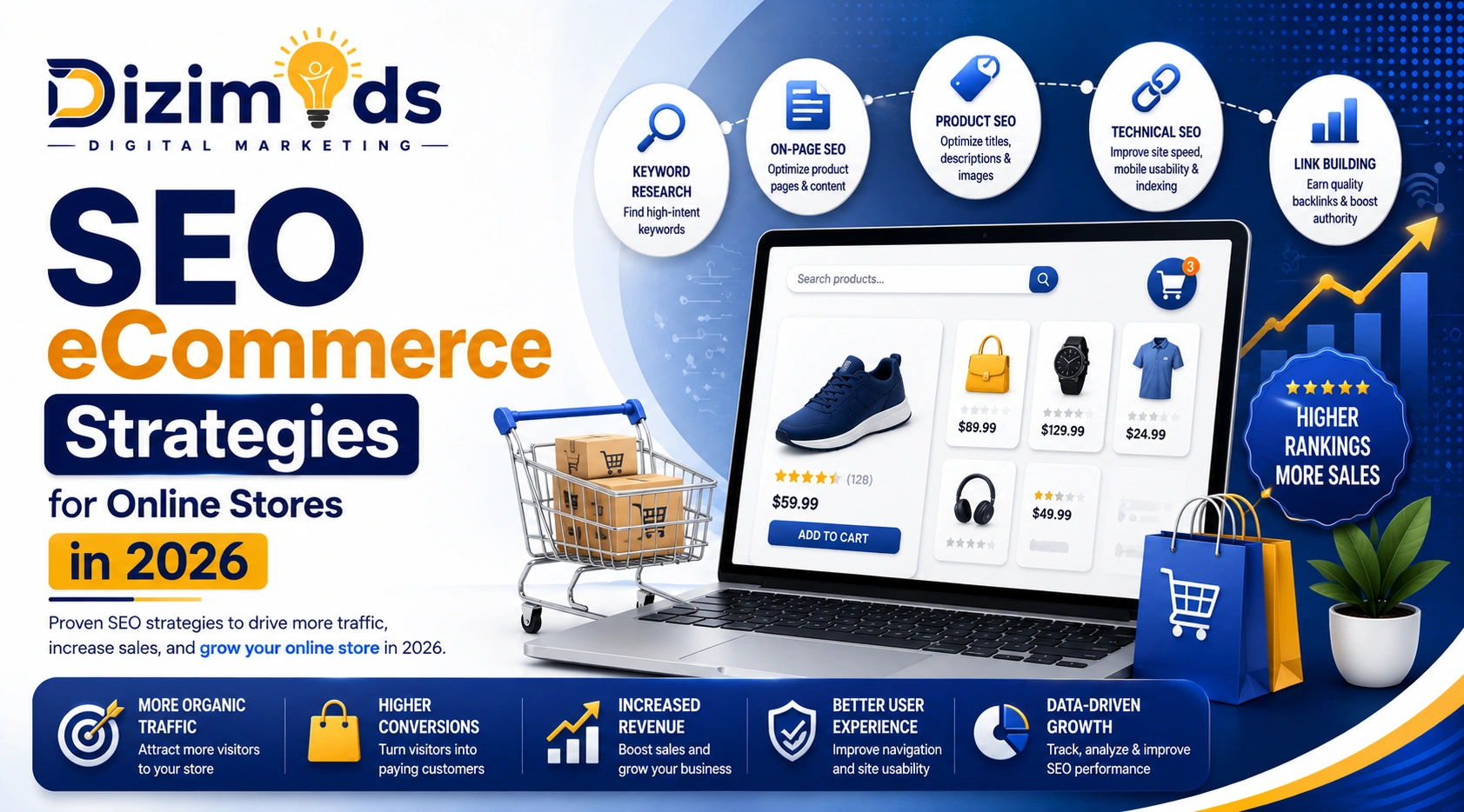
1. What eCommerce SEO Has To Do In 2026
2. Improve Start With Keyword Research And eCommerce SEO Intent
3. Map SEO Keywords to Category, Product and Content Pages
4. Build Category And Product Pages That Deserve To Rank
5. Use eCommerce SEO Best Content Practices
6. Make Navigation And Internal Links Work For Shoppers And Crawlers
7. Give Google Clean Product Data
8. eCommerce SEO Tips to Improve Control Crawl And Indexation On Large Stores
9. Account For Your eCommerce Platform
10. Connect SEO With CRO, Video, Mobile And Speed
11. Handle Product Lifecycle Problems Before They Cost Rankings
12. Improve SEO by Earning Links With Assets That Fit The eCommerce Category
SEO for eCommerce delivers the best results when customer demand, catalog structure, product information and essential SEO elements—including technical SEO, on-page optimization, off-page SEO, conversion rate optimization (CRO) and revenue analysis—work together toward a common business objective. At Dizimods, we help online stores align these critical components so the right customers can easily discover, engage with and purchase the products they need.
Despite the challenges of managing thousands of products, categories and inventory updates, organic search remains one of the most effective channels for driving qualified traffic to eCommerce websites. Unlike traditional lead generation websites, online stores rely on well-optimized category pages, product listings, variant pages, customer reviews, pricing, stock availability, content quality, internal linking, website speed and a seamless checkout experience to convert visitors into loyal customers. Dizimods specializes in optimizing every stage of this journey to maximize visibility, user experience and conversions.
An effective eCommerce SEO strategy extends far beyond keyword research and title tag optimization. It requires proper crawl management, structured product data, strategic internal linking, Core Web Vitals optimization, user-generated content, schema markup and continuous revenue analysis. At Dizimods, our SEO experts develop comprehensive eCommerce Service strategies that integrate all these elements into a unified framework, ensuring your online store not only ranks higher on search engines but also achieves sustainable business growth.
To keep pace with the evolving digital landscape, Dizimods has updated its proven eCommerce SEO methodology for 2026, incorporating the latest advancements in AI-powered search, Google AI Overviews, product structured data, faceted navigation optimization and modern eCommerce platforms. Our goal is to help businesses stay ahead of search engine updates while delivering exceptional shopping experiences that increase organic traffic, conversions and long-term revenue growth.
Read More Blog: Top 15 SEO Services Companies in Delhi NCR, India
What eCommerce SEO Has To Do In 2026

The purpose of SEO for an eCommerce site is to get prospective customers to the right product or category page and guide them through the offer to the point of sale. Ranking is part of the process, but it’s not the end goal.
According to Google, product data, site structure, URLs, pagination, reviews and structured data, help Google find and read your store content. Google focuses on these elements while parsing store sites. eCommerce SEO is beyond just the words. It’s about structuring your store so the catalog is clear.
The AI features that Google introduced have not changed the basics of SEO. According to Google’s AI features and SEO guidance, the fundamentals of SEO still apply and there are no extra rules or special structured data pertaining to AI features. While there is no extra structured data for clarity, AI Search does increase the necessity for it. Category and product pages do need structured data, but more importantly they need clear and visible answers and crawled text and signals.
The best eCommerce SEO incorporates the following:
- Keyword research and intent
- Optimization of Category and product pages
- Technical SEO
- Product and Structured Data
- Content and Internal Links
- Conversion Rate Optimization and Analytics
ach of these elements must be present in an SEO strategy or the eCommerce site may be able to rank but growth will be difficult to sustain.
Read More Blog: Top SEO Companies In India That Actually Deliver Results
Improve Start With Keyword Research And eCommerce SEO Intent
A keyword means a user search. A search term on an eCommerce site may be a general category like guitars, a commercial term like guitars for sale or a specific term like used 1970s Gibson guitar for sale that may even link to a specific product page.
Different user searches require different page types as demonstrated in that old article. Nike basketball shoes likely links to a category or collection page, whereas Nike Air Max 90 men’s size 11 more probably links to either a product page or a filtered collection page. Queries that include a SKU, model number, size, material, brand and fit, as well as replacement part queries, indicate high purchase intent.
The first step is learning how to interpret user search queries to determine the page that will rank. The following are some possible search queries that will help with eCommerce SEO:
Broad terms like running shoes or industrial fasteners.
- Modified and refined terms like women’s trail running shoes.
- Brand and product line queries like Audio-Technica M70x headphones.
- Queries that include SKU or part numbers, fit, size and material.
- Commercial search terms like buy, for sale, near me, bulk, wholesale, replacement, best, reviews, etc.
- Informational questions that may create a bias toward a purchase like how to choose running shoes.
Search Console and GA4 display what you already earn from your own site. Keyword tools can help add to that. Ahrefs, Semrush, Moz, Google Keyword Planner, Google Trends, Amazon search suggestions and ecommerce marketplace data can provide varied keyword lists. The tools you use for gathering keywords are not as important as the decisions you make thereafter. Which queries relate to which URLs? How should the URL you rank assist your customers?
Intent becomes the search query filter. If Google displays category pages for a query, it is likely time consuming to rank a single product page for the query. If Google displays buying guides for the query, your category page will likely need additional content in order to rank.
This is the reason the best eCommerce SEO practices and tips advocate for mapping first.
Read More Blog: Digital Marketing in India 2026
Map SEO Keywords to Category, Product and Content Pages
After understanding your keyword universe, you can implement your terms for page types. This will not only eliminate page redundancy, but will also help your team identify their efforts. Generally, category pages will contain the highest search value. These pages should cover searches by type of product, brand, use-case, material, audience and modifiers. An example of an optimized category page would be the page dedicated to red flannel hats. A page like this one would contain a clear introduction, searchable filters, links to subcategory pages, supportive FAQs and a product grid that displays multiple product offerings.
Competing product pages should be dedicated to searches for specific products, SKUs, models, variants, part numbers and bottom-funnel modifiers. These pages should contain unique content for each product, including descriptions, images, videos, reviews and information about shipping and returns. Products viewed on a page that contain the manufacturer’s description will give Google and shoppers no reason to view the page over other resellers.
Support catalog pages with dedicated content. This could include buying guides, product comparison pages, care guides and size guides. These pages support longer, more specific queries. These pages will help to establish authority for your product category pages with the goal of increasing sales.
Every search page should be optimized and every page should have a defined purpose.
Read More Blog: What is ORM in Digital Marketing
Build Category And Product Pages That Deserve To Rank

On-page optimization is important for eCommerce SEO, but eCommerce on-page SEO must align with the buying path. Title tags, meta descriptions, headers, product descriptions, image alt texts and internal links and should facilitate the understanding and usability of the page.
Category pages should contain:
- Title tags and H1s that correspond with the primary category demand.
- Intro copy that provides a description of the category and positions products as the furthest element on the page.
- Links to subcategories that correspond with the way customers refine their selections.
- Labels for product filters that use the most common terminology.
- Product grids that are sorted in a way that provides the most utility for comparison.
- Copy that provides a FAQ or guides for sizing, compatibility, materials, use cases, buying criteria, etc.
- Internal links that originate from a buying guide, navigational links, breadcrumbs, related category links and links from blog posts.
Product pages should have:
Descriptive product offerings that explain the use, fit, benefits and differentiators of the items.
Product titles that contain the model, brand, type and key characteristics.
- Clear product images with descriptive alt text.
- Review and Q&A features that address common purchase objections.
- Product related offerings that include the items, accessories and replacement options.
- Product structured data that corresponds with the content on the page.
Many eCommerce SEO projects run into trouble here. Teams will write product titles and meta descriptions but will leave the poor manufacturer copy, missing specs, poor internal links, duplicate variants and thin category pages. This will translate as weakness to search engines and shoppers.
Read More Blog: What Is SEO and How Does It Work?
Use eCommerce SEO Best Content Practices
The old version of this article made a useful point: long-tail content can support product and category pages. That is still true. The difference in 2026 is that content has to be more tightly connected to the catalog.
Good eCommerce content answers pre-purchase questions. It helps shoppers compare options, understand fit, avoid mistakes and choose with more confidence. A running shoe store might publish guides on trail surfaces, shoe rotation, injury prevention and sizing. A B2B parts distributor might publish fitment guides, standards explainers, interchange resources and maintenance checklists.
Useful content formats include:
- Buying guides.
- Comparison articles.
- Product care guides.
- Size and fit guides.
- Compatibility and fitment resources.
- Seasonal merchandising guides.
- Gift guides.
- Installation or how-to content.
- Glossaries for technical categories.
- Data studies or tools that can earn links.
Each content piece should have a routing plan. Link to the relevant category, product or collection page. Link back from categories when the guide helps the shopper decide. Use descriptive anchors. Keep the path natural. eCommerce internal linking is not just an SEO tactic. It is how you move shoppers and authority toward revenue pages.
Read More Blog: Best AI driven SEO Company in India
Make Navigation And Internal Links Work For Shoppers And Crawlers
Navigation and SEO are intertwined. Inadequate navigation leads to customer loss. Inadequate SEO leads to Google missing your strong pages.
Start with path hierarchy by focusing on how your homepage links to your department pages, category pages, sub-category pages, product pages and related content pages. Breadcrumbs should express path hierarchy. Important business pages should be HTML linked within your paths. Relying solely on JavaScript to link important pages is bad practice. Keep your XML sitemaps up to date on your canonical pages.
Next, focus on internal link equity. Pages that generate revenue should not be linked in layer 5 of your main paths. Pages with low traffic and utility should not be linked in layer 2 of your main navigation. Use internal links in your main navigation, category page copy, product and related content pages and footer hub pages.
Site search will reveal useful terms you do not use in your navigation. It will also help with product wordings and filters. If shoppers are searching for a specific size or a part to a product, consider creating that product page. Alternatively you can create a more specific page or a content filter.
Give Google Clean Product Data
Structured data describes the contents of a webpage in a way that is understandable to a search engine. For an eCommerce site, Product structured data is crucial. Google can show additional details in Product Rich Results, including price, availability, ratings, shipping and return details.
Google Product structured data help pages explain snippets and merchant listings. Where customers can purchase a product from you, Google merchant listing markup can provide additional product information, including availability, shipping, return policy and sizing or variant specific details. Google states that if structured data is combined with a Merchant Center feed, Google can better understand and confirm the product data.
This also confirms that product data needs to be accurate in real-time. If a customer sees a price on the webpage that is higher than what is on the feed, they will not be happy. If variant pages are inconsistent, reviews have been improperly marked or if products are shown to be out of stock, you are telling both Google and your customers that you can be trusted to give them the correct information.
Prioritize:
- Product name, image, brand, SKU, GTIN or MPN when available.
- Price, currency, sale price and price-validity logic.
- Availability and backorder status.
- Aggregate ratings and review markup that follows policy.
- Shipping and return details.
- Variant relationships for size, color, material and other options.
- Breadcrumb structured data.
- Merchant Center feed alignment.
Reviews and user-generated content help here, too. Good reviews add language buyers use in the real world. Product Q&A can answer objections that your base copy misses. But UGC needs governance: prevent spam, moderate claims and make sure review markup reflects visible reviews.
Read More Blog: The Complete Guide To Ecommerce SEO in 2026
eCommerce SEO Tips to Improve Control Crawl And Indexation On Large Stores

A significant number of eCommerce websites lose organic revenue with Technical SEO. A small store can have hundreds of important URLs. For a large store, once filters, sorting, pagination, internal search, variants and parameters go live, it can create millions of crawlable combinations.
Google’s crawl budget instruction is intended for large or frequently updated websites, but it can be applied for any growing catalog. Manage your URL inventory and control duplicates on your website. Keep your sitemaps up to date and avoid long redirect chains. For pages that have been removed, make sure you set them to 404 or 410. Remove all soft 404s.
Special attention should be given to faceted navigation. According to Google’s faceted navigation guidance, filters can create large or even infinite URL spaces. This can be over-crawled and can slow down the discovery of useful URLs. If the filtered URLs do not need to be crawled, do not allow them to be crawled. Make the choice to allow certain filtered pages to crawl and rank if you feel they should.
Common control decisions include:
- Which filters deserve indexable landing pages.
- Which parameter combinations should be crawlable, canonicalized, blocked or handled with fragments.
- Whether empty filter combinations return a real 404 instead of a soft 404.
- How pagination and infinite scroll expose crawlable product links.
- How internal search result pages are controlled.
- How variants consolidate or separate based on search demand.
- How discontinued and out-of-stock URLs are handled.
Be careful with noindex as a crawl-budget tool. Google still needs to crawl the page before seeing the directive. For large low-value URL sets, robots.txt, URL design, canonical consolidation and internal-link controls may be more appropriate depending on the situation. This is where Local SEO and development decisions have to work together.
Account For Your eCommerce Platform
The implementation of a particular SEO strategy can differ based on the platform. Thus, when doing SEO for eCommerce websites, CSMS, themes, app stacks, checkout models, developer workflows and more, should be taken into consideration.
SEO with Shopify usually focuses on theme speed, app bloat, product variants, duplicate collection and product paths and a shopify plus workflow.
SEO with WooCommerce usually relies on the WordPress theme and the bloat of plugins, product schema, a taxonomy structure and the hosting and WordPress database, as well as the product’s attributes and the archive pages those create.
SEO for both Magento and Adobe Commerce usually focuses on layered navigation, indexing and the more flexible side of canonical URLs, as well as the depth of categories and performance. Also, template changes that are backed by a developer.
With BigCommerce, you usually deal with product options, performance on the theme, checkout and URL bloat that is tied to the way BigCommerce structures categories. Same as feed work.
With custom platforms, things can go both ways. Usually, the best depends on whether you get crawlable navigation, metadata that’s editable, schema, sitemaps, control over the redirects, product data, performance and a clean URL structure with easy releases and the AI SEO Services built into the processes.
Connect SEO With CRO, Video, Mobile And Speed
SEO gets the customers to come. Conversion Rate Optimization gets the customers to spend. For eCommerce, both are essential.
Understand category-grid behavior, trust on product pages, review visibility, shipping and returns, add-to-cart friction, checkout, payment methods, site search, product recommendations and merchandising tests. As a rule of thumb, the higher a rank, the more valuable a page. Conversion Rate Optimization tests show the SEO Agency in India team what objections and attributes are most important and most often tested.
Product videos help, especially if the videos are original and add value. Helpful pages can show demonstrations, provide sizing info, show installation, provide product comparisons and combination video walkthroughs. Always keep the page performance in mind. Lazy loading, content protection and keeping the main product video content short can help.
Because so many customers start or complete their shopping journeys on mobile, mobile is always a focus. eCommerce sites with a mobile friendly design have product filtering, images, product sticky add to carts and product reviews and an easy checkout but don’t feel cluttered.
Speed is also an important part of the user experience. Google’s Core Web Vitals have Page Load Times of 2.5s or less for Largest Contentful Paint (LCP), 200ms or less for Interaction to Next Paint (INP) and a Cumulative Layout Shift (CLS) of less than 0.1. For eCommerce sites, Category, Product, Search, Cart and Content templates score the most. The homepage score won’t show what customers are waiting for.
Read More Blog: SEO Company in Chandigarh
Handle Product Lifecycle Problems Before They Cost Rankings
The antiquated guidance recommended not removing out-of-stock items. This should be similarly practiced here. Out of stock items influence rankings, links and user experience and impact revenue.
Pages for temporarily out of stock items should be kept live and their status should be shown. The schema should be preserved and email notifications and/or related products should be shown. For permanently discontinued products that are linked and/or demanded, evaluate the need to keep the page as a discontinued product or maybe redirect the page to the nearest substitute or to the most relevant product category. If there are no substitutes, consider serving a 404 or 410 instead of a redirect.
Plan ahead of time for expectation of returning demand, especially for out of stock products. Updates to copy, internal links, schema and product availability should be done for out of stock products ahead of time before the peak demand. Variants should not be let to thin out and become without links unless the search demand justifies the separate pages.
Lifecycle guidance and rules need to be standardized. Otherwise, merchandising, development and the SEO teams will be solving the same recurring problems in different ways monthly.
Read More Blog: Best SEO Company in Zirakpur
Improve SEO by Earning Links With Assets That Fit The eCommerce Category

Links continue to play an important role in helping search engines evaluate a website’s trust, authority and credibility. However, successful link earning for eCommerce websites only works when the content or asset is created with the target audience in mind. At Dizimods, we focus on building high-quality, relevant backlinks through valuable content rather than relying on low-quality directories or generic guest posts, which rarely provide long-term SEO benefits.
The most effective link-building strategies are centered around creating genuinely useful assets. These may include original research and data studies, in-depth buying guides, high-quality product photography, digital PR campaigns, interactive tools and educational resources. For example, a compatibility guide may attract valuable backlinks for retailers selling technical products, while a fashion or lifestyle brand may benefit more from original photography, seasonal trend reports or consumer insights. Dizimods develops customized content marketing and digital PR strategies that help businesses earn authoritative backlinks naturally while strengthening their online presence.
Link reclamation and broken link building also remain valuable SEO techniques. Identifying backlinks pointing to outdated or deleted pages that return 404 errors and redirecting them to relevant, updated content helps recover lost link equity and improve user experience. Similarly, if competitors have earned backlinks to outdated resources, creating a significantly more comprehensive and useful version gives your business a strong opportunity to earn those links ethically. At Dizimods, we prioritize sustainable white-hat link-building practices that comply with Google’s guidelines and support long-term search visibility.
For eCommerce retailers, link-building efforts should align closely with merchandising priorities, high-value product categories and overall content and digital PR strategies. Rather than building links indiscriminately, authority should be directed toward the pages that drive the greatest business impact, such as category pages, top-selling product collections and strategic landing pages. By combining technical SEO Services, content marketing and authoritative link-building, Dizimods helps online stores build lasting domain authority, improve search rankings, attract qualified organic traffic and achieve sustainable revenue growth.
Measure eCommerce SEO By Revenue, Not Only Rankings
Rankings and traffic matter, but they are not enough. eCommerce SEO should be measured by the business outcomes it can influence.
Track:
- Organic revenue.
- Transactions.
- Average order value.
- Conversion rate by landing page type.
- Non-brand clicks and impressions.
- Rankings for priority categories, products and content.
- Assisted conversions where available.
- Product and category pages gaining or losing traffic.
- Index coverage and crawl signals.
- Technical fixes shipped.
- Content, schema and internal-link updates shipped.
GA4, Search Console, rank tracking, crawl data and platform revenue reports each show a different part of the picture. The useful view combines them. If a category climbs from position 12 to position 5 but revenue does not move, look at intent, product mix, pricing, availability, SERP layout and conversion friction. If revenue improves while rankings stay flat, look for long-tail growth, better snippets, higher conversion rate or paid and organic interaction.
The goal is not a prettier dashboard. It is a clearer operating system for deciding what to fix next.
eCommerce SEO Strategy FAQs
Result-Driven SEO Agency Backed by Experience
Built for brands that want long-term growth – not shortcuts.