

Table of Contents
Every business wants to appear on the first page of Google, but achieving a strong Google ranking requires much more than simply publishing content. Search engines evaluate hundreds of signals before deciding which pages deserve the top positions in search results.
Over the years, Google’s algorithms have become smarter. Today, they focus on delivering the most relevant, trustworthy, and helpful content to users. Websites that provide an excellent user experience, demonstrate expertise, and meet search intent are far more likely to achieve sustainable rankings.
Whether you run an eCommerce store, a local business website, a corporate website, or a personal blog, understanding the latest Google Ranking Factors can help you build a long-term SEO strategy that drives consistent organic traffic.
In this guide, we’ll explain how Google ranks websites, the most important ranking factors in 2026, common SEO mistakes to avoid, and practical tips to improve your visibility in search results.
What is Google Ranking?

Google Ranking refers to the position of a webpage in Google’s search results for a specific keyword or search query.
For example, if someone searches for “SEO Services in India” and your website appears in the first position, your Google ranking for that keyword is #1.
Higher rankings generally result in:
- More organic traffic
- Better brand visibility
- Higher click-through rates
- More qualified leads
- Increased conversions
- Greater business credibility
Google determines rankings by evaluating hundreds of signals, including content quality, website performance, backlinks, user experience, and search intent.
Read More Blog: What is Amazon A+ Content
Why is Google Ranking Important?

Appearing on the first page of Google can significantly impact the growth of any online business. Studies consistently show that the majority of users click on results displayed on the first page, while very few continue to the second page.
Improving your Google ranking helps you:
Increase Organic Traffic
Higher rankings mean greater visibility, which naturally leads to more visitors without relying solely on paid advertising.
Build Trust and Credibility
Generate More Leads and Sales
Improve Brand Awareness
Even when users don’t immediately click on your website, appearing repeatedly in search results increases brand recognition over time.
Read More Blog: Ecommerce SEO The Complete Guide
How Does Google Rank Websites?

Google uses automated systems called Googlebot to discover, analyze, and organize web pages.
The ranking process generally follows four main stages:
1. Crawling
Googlebot discovers new pages by following links and reading XML sitemaps.
2. Indexing
After crawling, Google analyzes the page and stores it in its search index if it meets quality guidelines.
3. Understanding Content
Google evaluates:
- Content quality
- Search intent
- Keywords
- Images
- Videos
- Internal links
- Structured data
- User experience
4. Ranking
Finally, Google’s algorithms compare your page with thousands of competing pages before deciding its position in search results.
The better your overall SEO performance, the greater your chances of achieving higher rankings.
Read More Blog: Shopify SEO Guide
Top Google Ranking Factors in 2026
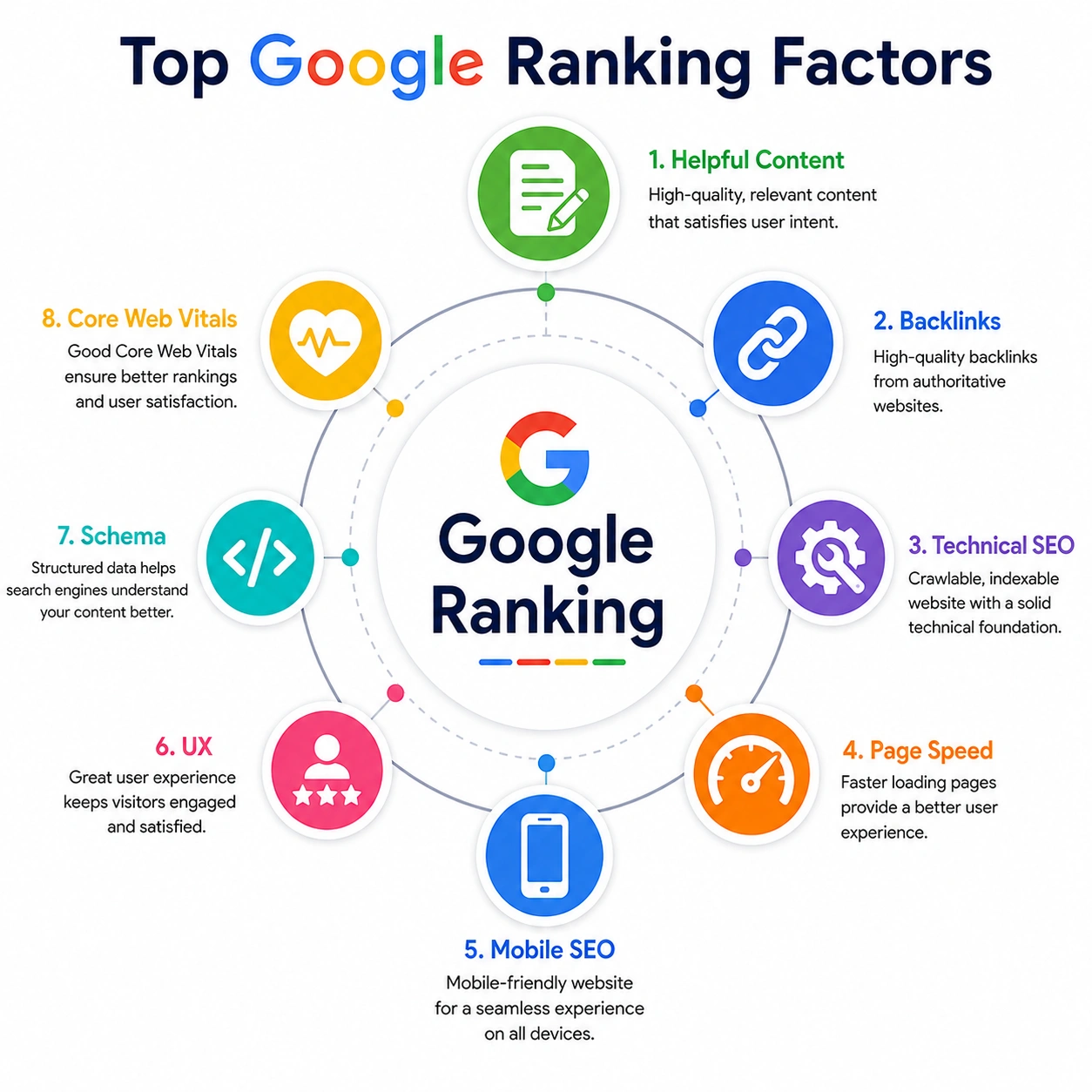
Google has confirmed that there isn’t a single factor responsible for rankings. Instead, multiple signals work together to determine where a page appears in search results.
Below are some of the most important ranking factors every website owner should understand.
1. Helpful, High-Quality Content

Content remains the foundation of SEO.
Google rewards content that provides genuine value, answers users’ questions, and demonstrates real expertise.
High-quality content should:
- Address the user’s search intent
- Be well-structured and easy to read
- Include original insights
- Use accurate and up-to-date information
- Answer related questions comprehensively
Rather than publishing large quantities of content, focus on creating fewer but more valuable pages.
2. Search Intent Optimization
One of the biggest reasons pages fail to rank is that they don’t satisfy the user’s intent.
Before creating content, ask:
- What information is the user looking for?
- Are they trying to learn something?
- Are they comparing products?
- Are they ready to make a purchase?
Matching your content with search intent significantly increases the likelihood of ranking.
3. E-E-A-T (Experience, Expertise, Authoritativeness, Trustworthiness)
Google places increasing importance on content created by experienced and trustworthy sources.
To strengthen E-E-A-T:
- Publish accurate information
- Showcase author expertise
- Keep content updated
- Reference credible sources where appropriate
- Build a trustworthy brand presence
E-E-A-T is especially important for competitive industries such as healthcare, finance, and legal services.
Read More Blog: Technical SEO Guide 2026
4. Technical SEO

Even the best content may struggle to rank if technical issues prevent search engines from accessing your website.
A strong technical foundation includes:
- Fast loading speed
- Mobile-friendly design
- Clean site architecture
- XML sitemap
- Robots.txt
- HTTPS security
- Canonical tags
- Proper indexing
Regular technical SEO audits help ensure your website remains optimized for search engines.
5. High-Quality Backlinks

Backlinks remain one of Google’s strongest ranking signals. When authoritative and relevant websites link to your content, they act as endorsements that increase your website’s credibility.
However, Google values quality over quantity. A few links from trusted websites are far more valuable than hundreds of low-quality backlinks.
Best Practices
- Earn backlinks from relevant websites.
- Publish original research and in-depth guides.
- Write guest posts on authoritative blogs.
- Build relationships within your industry.
- Avoid buying backlinks or using link schemes.
A natural backlink profile helps improve your Google ranking over time while reducing the risk of penalties.
6. Core Web Vitals

Google wants users to enjoy a fast and smooth browsing experience. Core Web Vitals measure how well your website performs in real-world conditions.
The three key metrics are:
Largest Contentful Paint (LCP)
Measures how quickly the main content loads.
Target: Less than 2.5 seconds.
Interaction to Next Paint (INP)
Measures how responsive your website is after a user interacts with it.
Lower response times create a better user experience.
Cumulative Layout Shift (CLS)
Measures visual stability.
Pages should avoid unexpected layout shifts caused by images, ads, or dynamic elements.
Target Score: Below 0.1.
Improving Core Web Vitals not only supports better rankings but also increases user satisfaction and conversion rates.
7. Mobile-First Indexing

Google primarily uses the mobile version of your website for indexing and ranking.
If your website performs poorly on smartphones or tablets, your rankings may suffer even if the desktop version is excellent.
Mobile SEO Checklist:
- Responsive website design
- Fast mobile loading speed
- Readable font sizes
- Touch-friendly buttons
- Optimized images
- Simple navigation
- No intrusive pop-ups
A seamless mobile experience is essential for achieving sustainable Google Rankings.
8. Website Speed

Page speed directly affects both user experience and SEO performance.
Slow-loading websites often experience:
- Higher bounce rates
- Lower engagement
- Reduced conversions
- Poor search visibility
Ways to Improve Website Speed:
- Compress images using WebP format.
- Enable browser caching.
- Minify CSS and JavaScript files.
- Remove unused code.
- Use a Content Delivery Network (CDN).
- Upgrade to reliable web hosting.
- Implement lazy loading for images and videos.
Even small improvements in loading time can have a significant impact on your rankings and user experience.
Read More Blog: What is SEO
9. Strong Internal Linking
Internal links help Google understand your website’s structure and distribute authority across important pages.
A well-planned internal linking strategy also encourages visitors to explore more content, increasing session duration and reducing bounce rates.
For example, if you publish a blog on Google Ranking, you can naturally link it to related articles such as:
- Technical SEO Guide
- SEO Audit Checklist
- Link-Building Strategies
- Keyword Research Guide
- On-Page SEO Checklist
This creates topical relevance and strengthens your overall SEO strategy.
10. Schema Markup
Schema markup is structured data that helps search engines understand the content on your website.
Proper schema implementation can improve your visibility by generating rich results in Google Search.
Common schema types include:
- Article Schema
- FAQ Schema
- Organization Schema
- Breadcrumb Schema
- Product Schema
- Local Business Schema
- Review Schema
Although schema is not a direct ranking factor, it can improve click-through rates by making your listings more informative.
Read More Blog: SEO Services Companies in Delhi
11. Image SEO
Images contribute to both user experience and search visibility.
Optimized images load faster, improve accessibility, and increase the chances of appearing in Google Images.
Image SEO Best Practices:
- Use descriptive filenames.
- Write meaningful alt text.
- Compress images before uploading.
- Use WebP format.
- Implement lazy loading.
- Choose appropriate image dimensions.
Optimized images enhance page performance while supporting better rankings.
12. Content Freshness
Google prefers content that remains accurate and relevant.
Rather than publishing new articles every day, regularly update your existing content with:
- Latest statistics
- Current SEO practices
- New screenshots
- Additional examples
- Updated internal links
Refreshing older content often leads to noticeable improvements in rankings without creating entirely new pages.
Read More Blog: What is ORM in Digital Marketing
13. User Experience (UX)
Google increasingly evaluates how users interact with your website.
A positive user experience encourages visitors to stay longer, engage with your content, and return in the future.
Key UX elements include:
- Clear navigation
- Readable typography
- Logical page structure
- Fast-loading pages
- Accessible design
- Easy-to-use menus
- Strong call-to-action placement
When users can quickly find what they’re looking for, search engines interpret this as a positive quality signal.
14. Secure Website (HTTPS)
Security is an essential part of modern SEO.
Google recommends that every website use HTTPS to protect user data.
Ensure your website has:
- A valid SSL certificate
- Secure internal resources
- Proper HTTP-to-HTTPS redirects
- No mixed-content warnings
A secure website builds trust with both users and search engines.
15. Search Intent Optimization

Many websites fail to rank because they target keywords without understanding why users search for them.
Every piece of content should align with the intent behind the query.
The four primary search intents are:
- Informational
- Navigational
- Commercial Investigation
- Transactional
Matching your content with user intent increases relevance and improves your chances of achieving higher Google Rankings.
16. On-Page SEO Optimization

On-page SEO is the process of optimizing individual web pages so they can rank higher in search results while providing a better experience for users.
Every page should clearly communicate its purpose to both search engines and visitors.
On-Page SEO Checklist:
- Write unique title tags for every page.
- Create compelling meta descriptions.
- Use one H1 heading per page.
- Organize content with H2 and H3 headings.
- Naturally include primary and secondary keywords.
- Optimize URLs with descriptive words.
- Add internal links to relevant pages.
- Use optimized images with descriptive alt text.
- Improve readability using short paragraphs and bullet points.
Strong on-page SEO helps search engines understand your content while making it easier for users to consume.
Read More Blog: SEO Company in Mohali
17. E-E-A-T: The Foundation of Google Rankings
Google gives preference to websites that demonstrate Experience, Expertise, Authoritativeness, and Trustworthiness (E-E-A-T).
This is especially important for websites that publish information related to health, finance, education, or legal topics.
How to Improve E-E-A-T:
- Publish content written or reviewed by knowledgeable professionals.
- Add a detailed author bio with relevant expertise.
- Keep articles updated with accurate information.
- Display business contact details and company information.
- Include customer testimonials or case studies where relevant.
- Build mentions and backlinks from reputable websites.
Trust is built over time through consistent quality, transparency, and authority.
18. Google's Helpful Content System
Google’s Helpful Content System rewards websites that create content primarily for people rather than search engines.
Instead of writing articles just to target keywords, focus on answering real questions and solving user problems.
Helpful content should:
- Address the reader’s intent clearly.
- Provide practical advice and actionable steps.
- Include examples and real-world scenarios.
- Be easy to read and well-structured.
- Avoid unnecessary repetition or keyword stuffing.
When users find your content genuinely useful, they are more likely to stay on your website, share your content, and return in the future.
19. AI Content and Google Ranking
Many businesses ask whether AI-generated content can rank on Google.
Google does not rank or penalize content simply because AI was used. Instead, it evaluates the quality, originality, usefulness, and accuracy of the content.
If AI is used, it should support the writing process rather than replace human expertise.
Best Practices:
- Add your own experience and insights.
- Verify facts before publishing.
- Include original examples and case studies.
- Edit AI-generated drafts thoroughly.
- Ensure the content satisfies user intent.
High-quality, people-first content has a much better chance of ranking than generic or repetitive articles.
Read More Blog: Best SEO Company in Zirakpur
20. Local SEO and Google Ranking
For businesses serving specific locations, local SEO plays a major role in improving Google ranking.
Optimizing your local presence increases visibility in Google Search and Google Maps.
Local SEO Best Practices:
- Complete your Google Business Profile.
- Keep your business name, address, and phone number consistent across directories.
- Collect genuine customer reviews.
- Create location-specific landing pages.
- Use local keywords naturally in your content.
- Build citations from trusted business directories.
Local optimization helps connect your business with customers searching for services in your area.
21. Common Google Ranking Mistakes

Even well-designed websites can lose rankings if common SEO mistakes are ignored.
Avoid these issues:
- Publishing thin or duplicate content.
- Ignoring search intent.
- Slow website speed.
- Poor mobile experience.
- Missing title tags or meta descriptions.
- Broken internal links.
- Weak backlink profile.
- Keyword stuffing.
- Outdated content.
- Missing structured data.
Regular SEO audits help identify and resolve these issues before they impact your performance.
Read More Blog: Local SEO Checklist
Google Ranking Improvement Checklist

Use this checklist to evaluate your website regularly:
✔ Publish original, high-quality content.
✔ Match every page with the correct search intent.
✔ Improve Core Web Vitals.
✔ Optimize page speed.
✔ Ensure mobile-friendly design.
✔ Build high-quality backlinks.
✔ Strengthen internal linking.
✔ Add schema markup.
✔ Update older content.
✔ Optimize images.
✔ Use HTTPS across the website.
✔ Monitor performance in Google Search Console.
✔ Track rankings and organic traffic.
✔ Fix crawl and indexing issues.
Consistently following these practices can strengthen your website’s long-term search performance.
Conclusion
Achieving a strong Google ranking is not about optimizing a single factor—it’s about creating a website that consistently delivers value to users while following SEO best practices.
Focus on publishing helpful content, improving technical performance, optimizing user experience, earning high-quality backlinks, and regularly updating your website. These efforts work together to build authority and improve your visibility in search results over time.
SEO is an ongoing process, and businesses that invest in continuous optimization are better positioned to attract organic traffic, generate qualified leads, and achieve sustainable growth.
Improve Your Google Ranking with Dizimods

At Dizimods, we help businesses build long-term SEO success through data-driven strategies and ethical optimization practices. Our services include technical SEO, on-page SEO, content optimization, SEO audits, link building, local SEO, Shopify SEO, and performance monitoring.
Whether you’re launching a new website or looking to improve existing rankings, our team focuses on practical solutions that enhance visibility, increase organic traffic, and support measurable business growth.
Frequently Asked Questions (FAQs)
Some of the most influential factors include:
- High-quality content
- Search intent optimization
- Backlinks
- Technical SEO
- Core Web Vitals
- Mobile-friendly design
- Internal linking
- E-E-A-T
- Website security (HTTPS)
- User experience
Result-Driven SEO Agency Backed by Experience
Built for brands that want long-term growth – not shortcuts.