
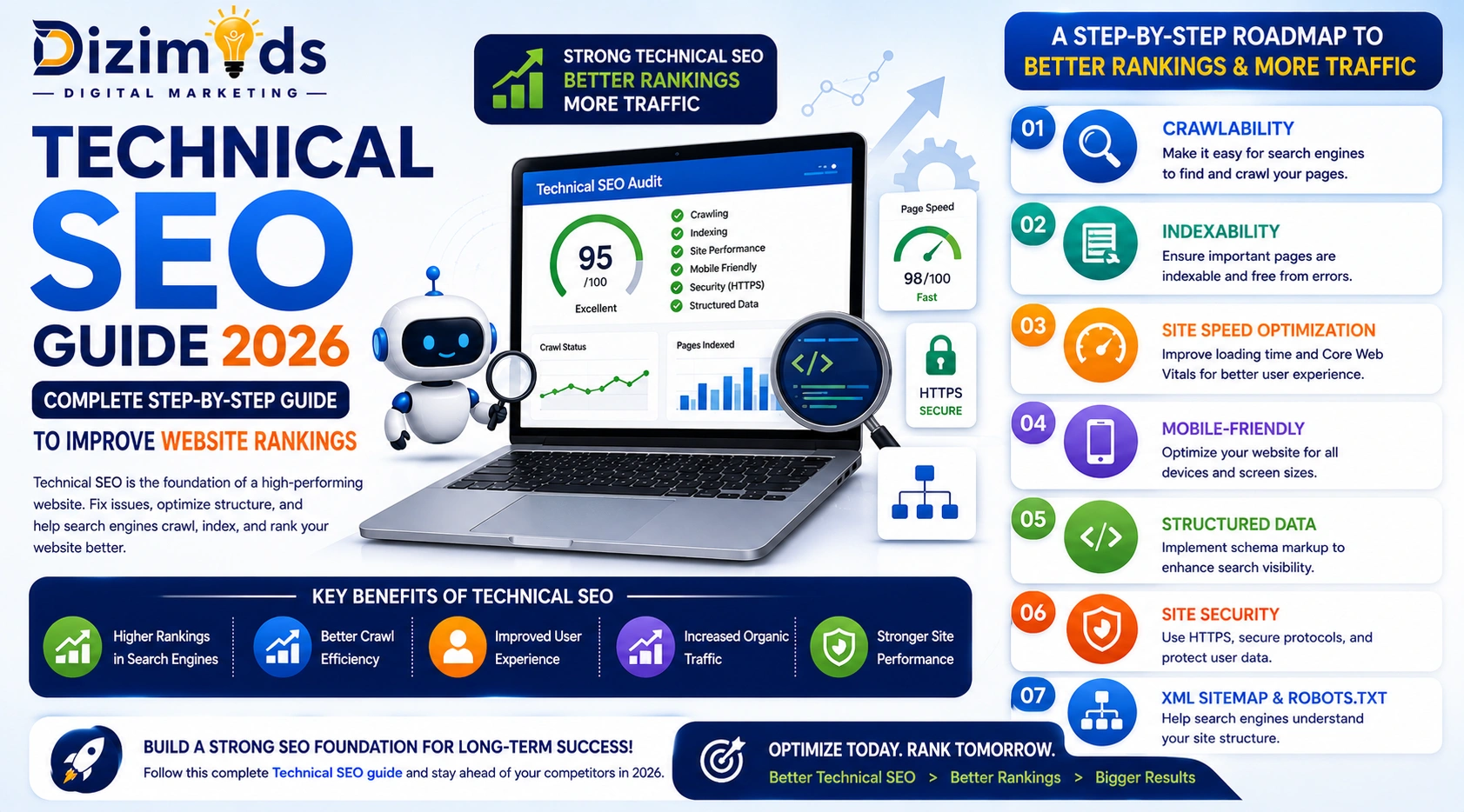
Technical SEO is the foundation of every successful SEO strategy. You can publish high-quality content and build strong backlinks, but if search engines cannot properly crawl, understand, and index your website, achieving higher rankings becomes difficult.
This complete Technical SEO Guide explains everything you need to know—from website crawling and indexing to Core Web Vitals, structured data, mobile optimization, HTTPS security, XML sitemaps, and much more.
Whether you own an eCommerce website, Shopify store, business website, SaaS platform, or blog, following this guide will help improve your search visibility and organic traffic.
What is Technical SEO?

Technical SEO is the process of optimizing a website’s technical infrastructure so search engines like Google can efficiently crawl, index, and understand its pages.
Unlike On-Page SEO, which focuses on content and keywords, Technical SEO improves the website’s backend performance, structure, speed, and accessibility.
Technical SEO helps search engines discover every important page while providing users with a faster and smoother browsing experience.
Why is Technical SEO Important?

Technical SEO directly impacts search engine visibility because it ensures that Google can properly access and evaluate your website.
Benefits include:
- Faster indexing
- Better crawl efficiency
- Improved website speed
- Enhanced Core Web Vitals
- Better user experience
- Higher keyword rankings
- Reduced crawl errors
- Increased organic traffic
- Better mobile usability
- Stronger website security
Technical SEO Checklist (2026)

1. Website Crawlability
Local Search engines must be able to access every important page.
Check:
- Robots.txt
- Internal linking
- Crawl errors
- Broken links
- Redirect chains
2. Website Indexing
Not every crawled page gets indexed.
Regularly monitor:
- Indexed pages
- Excluded pages
- Duplicate pages
- Noindex tags
- Canonical issues
3. XML Sitemap

A properly optimized XML sitemap helps Google discover important pages faster.
Include:
- Service pages
- Category pages
- Blog pages
- Product pages
Avoid:
- Redirect URLs
- Error pages
- Duplicate pages
4. Robots.txt Optimization

The Robots.txt file tells search engines which sections of your website they should crawl or ignore.
Common mistakes include:
- Blocking CSS
- Blocking JavaScript
- Blocking important pages
- Missing sitemap reference
5. HTTPS Security
Google considers HTTPS a ranking signal.
Always ensure:
- SSL certificate installed
- No mixed content
- Secure redirects
- HTTPS version indexed
6. Website Speed Optimization

A slow website increases bounce rate and reduces rankings.
Improve speed by:
- Compressing images
- Enabling browser caching
- Minifying CSS
- Minifying JavaScript
- Using CDN
- Removing unused code
- Lazy loading images
Core Web Vitals

Google evaluates website performance using Core Web Vitals.
Focus on improving:
Largest Contentful Paint (LCP)
Measures loading speed.
Target:
- Less than 2.5 seconds
Interaction to Next Paint (INP)
- Measures responsiveness.
- Lower response times improve user experience.
Cumulative Layout Shift (CLS)
- Measures visual stability.
- Avoid unexpected movement of page elements.

Mobile-Friendly Website

More than half of web traffic comes from mobile devices.
Ensure your website has:
- Responsive design
- Mobile-friendly fonts
- Proper spacing
- Fast loading
- Clickable buttons
- Easy navigation
Structured Data (Schema Markup)

Schema helps search engines understand your content better.
Popular schema types include:
- Organization
- Local Business
- FAQ
- Product
- Review
- Breadcrumb
- Article
- BlogPosting
- Person
Rich results can improve click-through rates.
Canonical Tags
Canonical tags prevent duplicate content issues.
Use canonical URLs when:
- Similar product pages exist
- Parameters generate duplicate URLs
- Category filters create multiple versions
URL Structure
AI SEO-friendly URLs should be:
- Short
- Descriptive
- Keyword-rich
- Easy to read
- Hyphen-separated
Example:
- example.com/technical-seo-guide
Avoid:
- example.com/page?id=489374&cat=33
Internal Linking Strategy
Internal links help search engines understand your website structure.
Link your:
- Blog to services
- Services to case studies
- Category pages
- Product pages
- Related blogs
- This distributes page
- authority throughout the website.
Broken Link Optimization
Broken links waste crawl budget and create poor user experience.
Regularly check:
- 404 pages
- Internal broken links
- External broken links
- Image errors
Breadcrumb Navigation
Breadcrumbs improve navigation for both users and search engines.
Example:
Home → SEO Services → Technical SEO Guide
Crawl Budget Optimization
Large websites should optimize crawl budget by removing:
- Duplicate pages
- Thin pages
- Parameter URLs
- Soft 404 pages
- Redirect chains
- This allows Googlebot to focus on important pages.
Common Technical SEO Mistakes

Many websites lose rankings because of avoidable technical issues.
Common mistakes include:
- Slow website speed
- Duplicate content
- Missing canonical tags
- Broken internal links
- Poor mobile experience
- Incorrect robots.txt
- Missing XML sitemap
- Redirect loops
- Missing schema markup
- Large image sizes
- Crawl errors
- Indexing issues
Best Technical SEO Tools

Professional SEO experts commonly use:
- Google Search Console
- Google Analytics 4
- Screaming Frog SEO Spider
- Ahrefs
- SEMrush
- PageSpeed Insights
- Lighthouse
- Rich Results Test
- GTmetrix
Technical SEO Best Practices (2026)
- Keep website architecture simple.
- Fix crawl errors regularly.
- Improve Core Web Vitals.
- Monitor indexing weekly.
- Use structured data.
- Optimize images.
- Secure your website with HTTPS.
- Maintain XML sitemap.
- Audit technical issues monthly.
- Build a strong internal linking structure.
Conclusion
Technical SEO is not a one-time task—it requires continuous monitoring and optimization. A technically sound website allows search engines to crawl, index, and rank your content more efficiently while providing users with a faster, safer, and smoother experience.
If you want sustainable organic growth, Technical SEO should be one of your highest priorities. Combined with high-quality content, keyword optimization, and authoritative backlinks, a strong technical foundation can significantly improve your website’s visibility and long-term rankings.
Frequently Asked Questions (FAQs)
Every website—including Shopify stores, WordPress websites, eCommerce seo platforms, SaaS websites, corporate sites, and blogs—benefits from Technical SEO.
Result-Driven SEO Agency Backed by Experience
Built for brands that want long-term growth – not shortcuts.