

Table of Contents
Launching an ecommerce website is easier than ever, but attracting consistent customers without relying entirely on paid advertising is one of the biggest challenges online businesses face. Whether you sell fashion products, electronics, beauty items, furniture, or industrial goods, your customers usually begin their buying journey with a Google search. If your products aren’t visible in search results, you’re likely losing potential sales to competitors.
This is where Ecommerce SEO becomes essential.
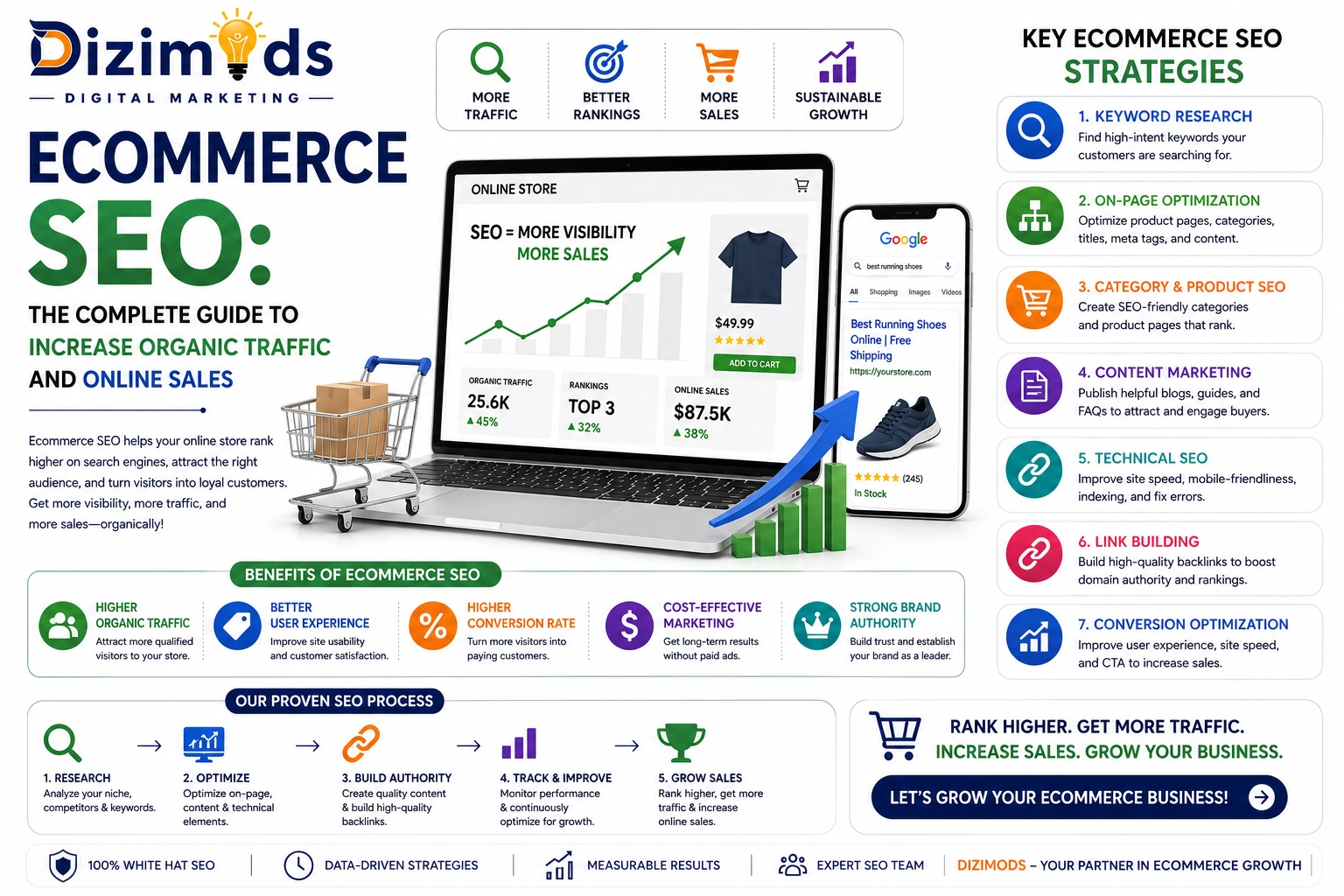
Ecommerce SEO is more than adding keywords to product pages. It involves optimizing your website’s structure, category pages, product listings, content, technical performance, and user experience so search engines can understand your website and confidently recommend it to users.
At Dizimods, we’ve seen that ecommerce businesses focusing on long-term SEO often build a more sustainable source of traffic than those relying only on paid campaigns. A well-planned SEO strategy not only increases visibility but also attracts visitors who are already looking for products similar to yours.
In this guide, we’ll explain the practical strategies that help ecommerce websites improve rankings, increase organic traffic, and generate more sales.
Read More Blog: eCommerce Service Provider for Amazon & Flipkart Sellers in India
What is Ecommerce SEO?

Ecommerce SEO is the process of optimizing an online store so its products, categories, and informational pages appear higher in search engine results for relevant customer searches.
Unlike a regular business website, an ecommerce site may contain hundreds or thousands of product pages. Without proper optimization, search engines can struggle to understand which pages are most valuable.
A successful Ecommerce SEO strategy focuses on:
- Optimizing product pages with unique content
- Improving category pages
- Conducting keyword research based on buying intent
- Strengthening internal linking
- Enhancing website speed and mobile experience
- Fixing technical SEO issues
- Building authority through high-quality backlinks
The goal isn’t just to attract visitors—it’s to attract users who are ready to compare products or make a purchase.
Read More Blog: The Complete Guide To Ecommerce SEO in 2026
Why is Ecommerce SEO Important?

Many ecommerce businesses invest heavily in paid advertising. While ads can generate immediate traffic, they stop delivering results as soon as the budget ends.
SEO works differently.
A properly optimized ecommerce website can continue attracting visitors for months or even years through organic search results.
Some of the key benefits include:
Increasing Organic Traffic
Higher Conversion Potential
Better Brand Credibility
Lower Long-Term Marketing Costs
Although Local SEO requires time and consistent effort, it can reduce dependence on paid advertising and improve your long-term return on investment.
Read More Blog: Ecommerce Success: Don’t Just Survive, Thrive: The Ultimate
How Search Intent Impacts Ecommerce SEO

One of the most common AI SEO mistakes is targeting keywords without understanding why people are searching.
Search intent generally falls into four categories:
Informational Intent
Example:
- How to choose running shoes
- Best skincare routine
These users are researching before buying.
Commercial Investigation
Example:
- Best wireless headphones under ₹5000
- Shopify vs WooCommerce
These users are comparing products or services.
Transactional Intent
Example:
- Buy gaming laptop online
- Men’s leather wallet price
These users are ready to make a purchase.
Navigational Intent
Example:
- Nike official store
- Apple India
Users already know the brand they want.
A successful Ecommerce Shopify SEO strategy targets all four stages by creating a mix of educational blog posts, category pages, comparison content, and optimized product pages.
Read More Blog: Drive Growth: Expert-Approved Ecommerce Tools and Services Unveiled
Ecommerce SEO Checklist

Before investing in advanced SEO strategies, ensure your website covers these essential ar eas:
- Perform keyword research based on customer intent.
- Write unique product titles and descriptions.
- Optimize category pages with helpful content.
- Use descriptive image file names and ALT text.
- Improve website speed and Core Web Vitals.
- Ensure mobile-friendly navigation.
- Fix broken links and redirect errors.
- Add structured data (Schema Markup).
- Create a logical internal linking structure.
- Publish educational blog content regularly.
- Monitor indexing using Google Search Console.
- Track organic performance with Google Analytics.
Completing these fundamentals creates a strong SEO foundation before moving to advanced optimization.
Product Page SEO: Turn Product Pages into Sales Pages

Product pages are often the biggest source of organic traffic for an ecommerce website. However, many online stores make the mistake of using the manufacturer’s product description on every page. This creates duplicate content, making it harder for Google to understand why your page deserves to rank.
Instead, every product page should provide original and useful information that helps customers make informed buying decisions.
Essential Product Page SEO Elements
A well-optimized product page should include:
- A unique and keyword-rich product title
- Original product description
- High-quality images with descriptive ALT text
- Product specifications
- Customer reviews
- FAQs
- Shipping and return policy
- Related products
Example
Instead of writing:
Men’s Black Backpack
Write:
Men’s Black Waterproof Laptop Backpack – 35L Travel & Office Bag
This gives both users and search engines a clear understanding of the product.
Pro Tip: Focus on benefits, not just features. Explain how the product solves a problem or improves the customer’s experience.
Read More Blog: What is Omnichannel E-commerce
Category Page SEO: The Most Underrated Ranking Opportunity

Category pages often rank better than individual product pages because they target broader search queries.
For example:
Instead of optimizing only one product for “Running Shoes”, create a category page targeting “Men’s Running Shoes” with multiple relevant products.
An optimized category page should include:
- SEO-friendly H1 heading
- Introductory content (200–400 words)
- Relevant filters
- Internal links to subcategories
- FAQs
- Optimized meta title and description
Avoid creating empty category pages with only product listings. Adding helpful introductory content improves relevance and user experience.
Read More Blog: Boom Your Ecommerce Sales with Dizimods’ Digital Marketing Magic 2026
Technical Ecommerce SEO

Technical SEO ensures that search engines can crawl, index, and understand your ecommerce website efficiently.
Improve Website Speed
Slow-loading websites increase bounce rates and reduce conversions.
Optimize your store by:
- Compressing images
- Using WebP image format
- Removing unused apps and scripts
- Enabling browser caching
- Minifying CSS and JavaScript
- Choosing a fast and lightweight theme
Mobile Optimization
Most ecommerce visitors browse and shop using smartphones.
Your website should:
- Load quickly on mobile devices
- Have responsive layouts
- Use readable font sizes
- Provide easy navigation
- Display clickable buttons properly
XML Sitemap & Robots.txt
Submit your XML sitemap in Google Search Console and ensure important pages are crawlable. Regularly check for indexing errors and fix them promptly.
Read More Blog: Optimizing Your Approach: Essential Digital Marketing Success
Build a Strong Internal Linking Strategy

Internal linking helps search engines discover important pages while guiding users to related products and content.
Examples include:
- Link blog articles to relevant product categories.
- Connect related products.
- Add “You May Also Like” sections.
- Link category pages to buying guides.
For example, a blog on “How to Choose the Right Office Chair” can naturally link to your Office Chairs category page.
This improves both SEO and user engagement.
Read More Blog: The Impact of JioMart Ratings & Reviews by Dizimods
Content Marketing for Ecommerce SEO

Publishing informative content helps attract users before they are ready to buy.
Instead of writing only promotional articles, answer the questions your customers ask.
Examples include:
- How to Choose the Right Running Shoes
- Cotton vs Polyester: Which Fabric Is Better?
- Top 10 Gifts for New Parents
- Beginner’s Guide to Home Gym Equipment
Helpful content builds trust and supports your product pages through internal linking.
Read More Blog: Crush the Competition: Ecommerce Sales Strategies from Dizimods
Link Building for Ecommerce Websites

Backlinks remain one of Google’s important ranking signals.
Rather than purchasing low-quality backlinks, focus on earning links naturally.
Some effective methods include:
- Guest posting on relevant websites
- Publishing original research or industry reports
- Creating shareable infographics
- Collaborating with bloggers and influencers
- Getting listed in trusted business directories
- Digital PR campaigns
- Quality always matters more than quantity.
Read More Blog: Ecommerce SEO Guide: How to Rank Your Online Store on Google
Common Ecommerce SEO Mistakes

Avoid these mistakes that can limit your website’s growth:
- Copying manufacturer product descriptions
- Publishing duplicate title tags and meta descriptions
- Ignoring category page optimization
- Using large, uncompressed images
- Not adding ALT text to images
- Weak internal linking
- Keyword stuffing
- Creating thin content
- Ignoring Core Web Vitals
- Not monitoring Google Search Console
Regular SEO audits help identify these issues before they affect rankings.
Read More Blog: Digital Marketing in 2026
EEAT Tips for Ecommerce Websites

Google wants to recommend websites that users can trust.
To strengthen your site’s Experience, Expertise, Authoritativeness, and Trustworthiness:
- Write original content based on real knowledge and experience.
- Display complete business information, including contact details.
- Publish clear shipping, return, and refund policies.
- Showcase authentic customer reviews.
- Keep product information accurate and up to date.
- Regularly update older content with new insights and data.
These practices improve user confidence and support long-term SEO performance.
Read More Blog: Top 10 Digital Marketing Agencies in India (2026)
Conclusion

Ecommerce SEO is not about chasing shortcuts or quick rankings. It’s about building an online store that is easy for customers to use and easy for search engines to understand.
By creating valuable product pages, optimizing category pages, improving technical performance, publishing helpful content, and earning quality backlinks, you can build a stronger online presence over time.
SEO requires patience, but businesses that invest consistently often benefit from increased visibility, qualified traffic, and long-term growth.
Frequently Asked Questions (FAQs)
Result-Driven SEO Agency Backed by Experience
Built for brands that want long-term growth – not shortcuts.