

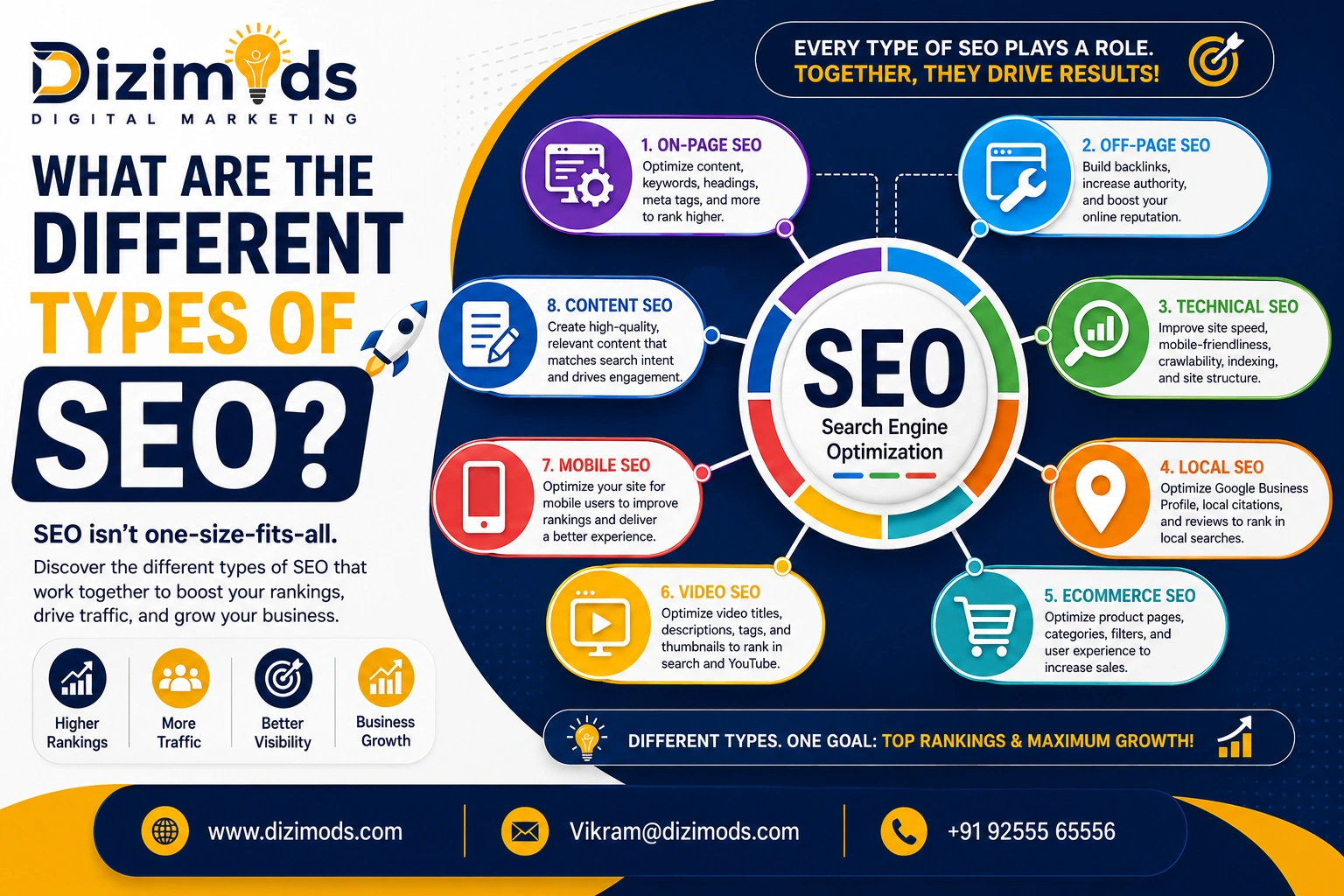
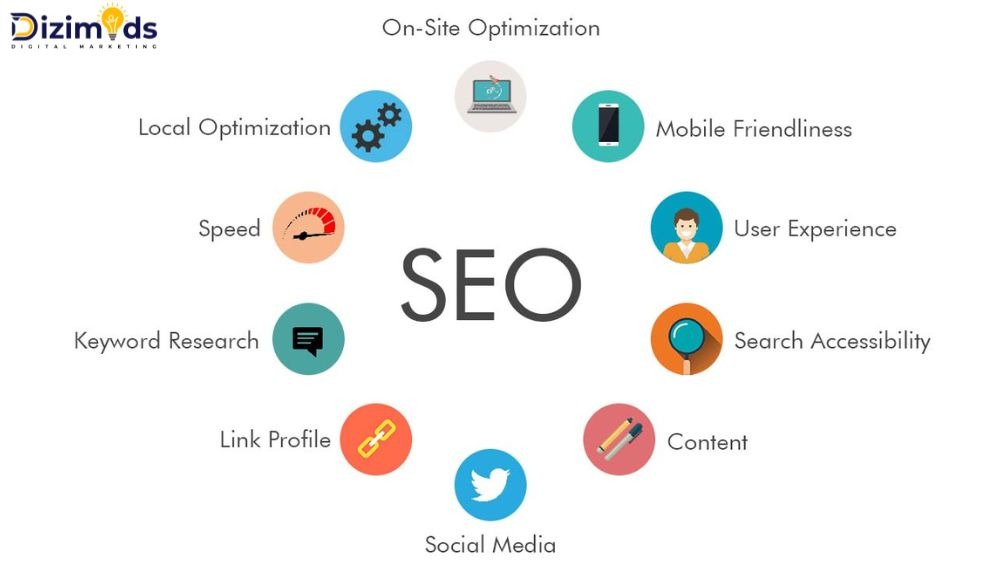
Before exploring the types of SEO, it’s important to understand what SEO actually is. SEO or Search Engine Optimization, is the process of enhancing your website to improve its ranking on search engine results pages (SERPs) for relevant keywords or search queries. The goal is to increase the number of visitors to your site by ensuring it ranks higher than competitors. If you’re new to SEO, check out our detailed guide on What is SEO? for deeper insights.
In this post, we will break down the various types of SEO, explain their significance and show you how each type contributes to a successful organic search strategy. By mastering these SEO techniques, you’ll be able to optimize your website effectively and improve its ranking in search engine results.
What Are the Types of SEO?
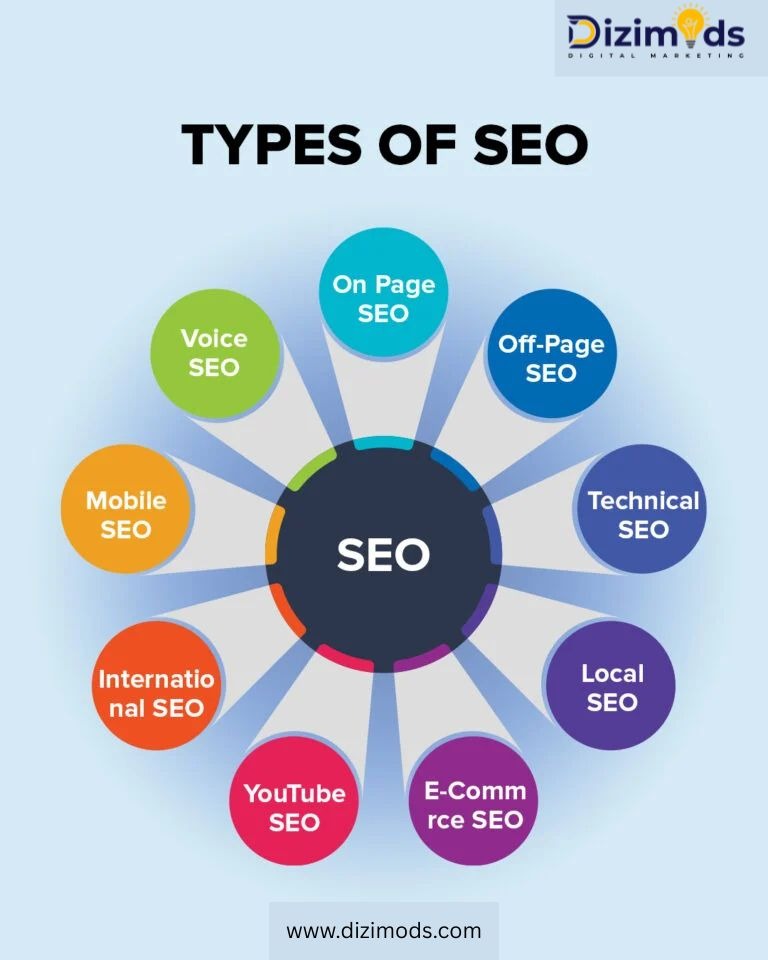
Master the different types of SEO driving success in 2026, from On-Page and Off-Page to advanced SEO strategies.
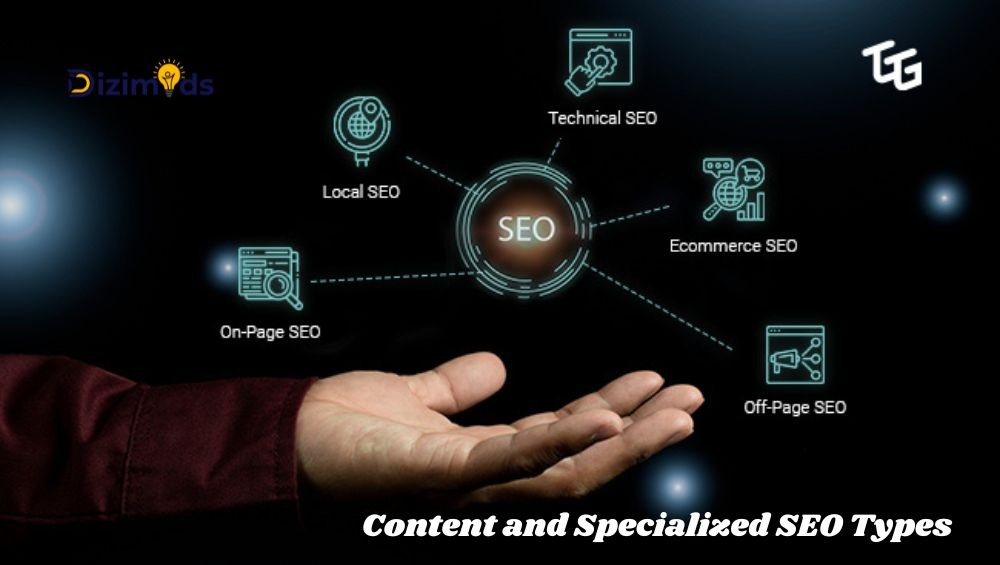
| Types of SEO | Description |
| On-Page SEO | All the measures you take to make your web page rank higher on search engine results pages (SERP) falls under On-Page SEO. |
| Off-Page SEO | This refers to everything you do outside of your site to fare better and feature higher up in Google’s SERPs. |
| Technical SEO | It is largely to help Google bots successfully crawl, interpret and index all the pages of your site for future use. |
| Local SEO | Focuses on optimizing a business’s online presence to attract local customers through Google search results and Google Maps. |
| E-commerce SEO | Involves optimizing online stores to improve their visibility and rankings on search engines, driving more traffic and sales. |
| YouTube SEO | Optimizes video content on YouTube to increase visibility, attract viewers and improve engagement through strategies like video titles, descriptions, tags and thumbnails. |
| International SEO | Targets global audiences by optimizing websites to rank well in multiple countries and languages. |
| Mobile SEO | Ensures websites are optimized for mobile devices, improving user experience and search rankings on smartphones and tablets. |
| Voice SEO | Adapts SEO strategies for voice search, focusing on conversational keywords and featured snippets to cater to voice-activated searches. |
1. On-Page SEO
On-page SEO is all about making changes to your website to help it show up higher in search results. It includes things like using the right keywords in your content, internal linking, making sure your page loads quickly and adding helpful titles and descriptions. Basically, On-Page SEO makes sure both search engines and people can easily understand what your page is about and find what they need.
You May Also Like:
Importance of On-Page SEO
The Importance of On-Page SEO lies in its ability to make your website more visible in SERPs (Search Engine Results Pages). When your web pages are optimized, search engines can better understand what your content is about, leading to higher rankings. This means more people are likely to find your site and visit it.
On-Page SEO also ensures that your content matches what users are searching for, improving their experience and encouraging them to stay on your site longer. Without it, even the best content can get lost, making it harder to reach your audience.
Key Elements of On-Page SEO
On-page SEO is one of the types of SEO in digital marketing. It is the process of optimizing web page elements, such as content, internal links, URLs, headline tags, etc., to improve website rankings in SERPs (Search Engine Results Pages) and drive increased traffic.
Here’s what is included in on-site SEO:
- SEO Keyword Research
Keyword research refers to the process of researching popular keywords and phrases used by searchers and embedding them strategically into your website content. With robust keyword research, your web pages can rank higher in relevant search queries and drive more traffic which leads to increased brand awareness.
- Quality Content Creation
One of the most important elements of on-page SEO is content quality. Your website content must be informative, accurate, easy to read and in sync with the search engine’s quality standards. The content must also include relevant keywords and links to ensure it ranks higher in SERPs and build your trustworthiness in the long run.
- Internal Linking SEO Strategy
Internal linking for SEO refers to the process of connecting different pages of a website through links. Links help search engines identify new web pages and rank them in relevant search queries. It also allows users to navigate through a website seamlessly, enhancing user experience.
- Metadata SEO Optimization
Metadata SEO optimization refers to optimizing the HTML components of a website, such as header tags, title tags and meta descriptions which allow users and search engines to understand what the page is about. This helps a web page grab higher rankings and visibility in search engine results.
- Image SEO Optimization
Images make a website more attractive, accessible and engaging to users. Therefore, they must be of high quality with the ideal format, resolution and size. SEO optimization of images involves optimizing descriptive file names, captions, sizes and alt tags of your website’s images. It not only helps in improving user engagement but also improves your SERP rankings and increases traffic.
- URL Structure
URL (Uniform Resource Locator) is the web address that helps users access a web page. URL structure refers to the organization of your website’s URLs by including relevant keywords. A logical URL structure helps improve user experience and allows search engines to identify the content of a webpage and crawl and index them for rankings.
2. Off-Page SEO
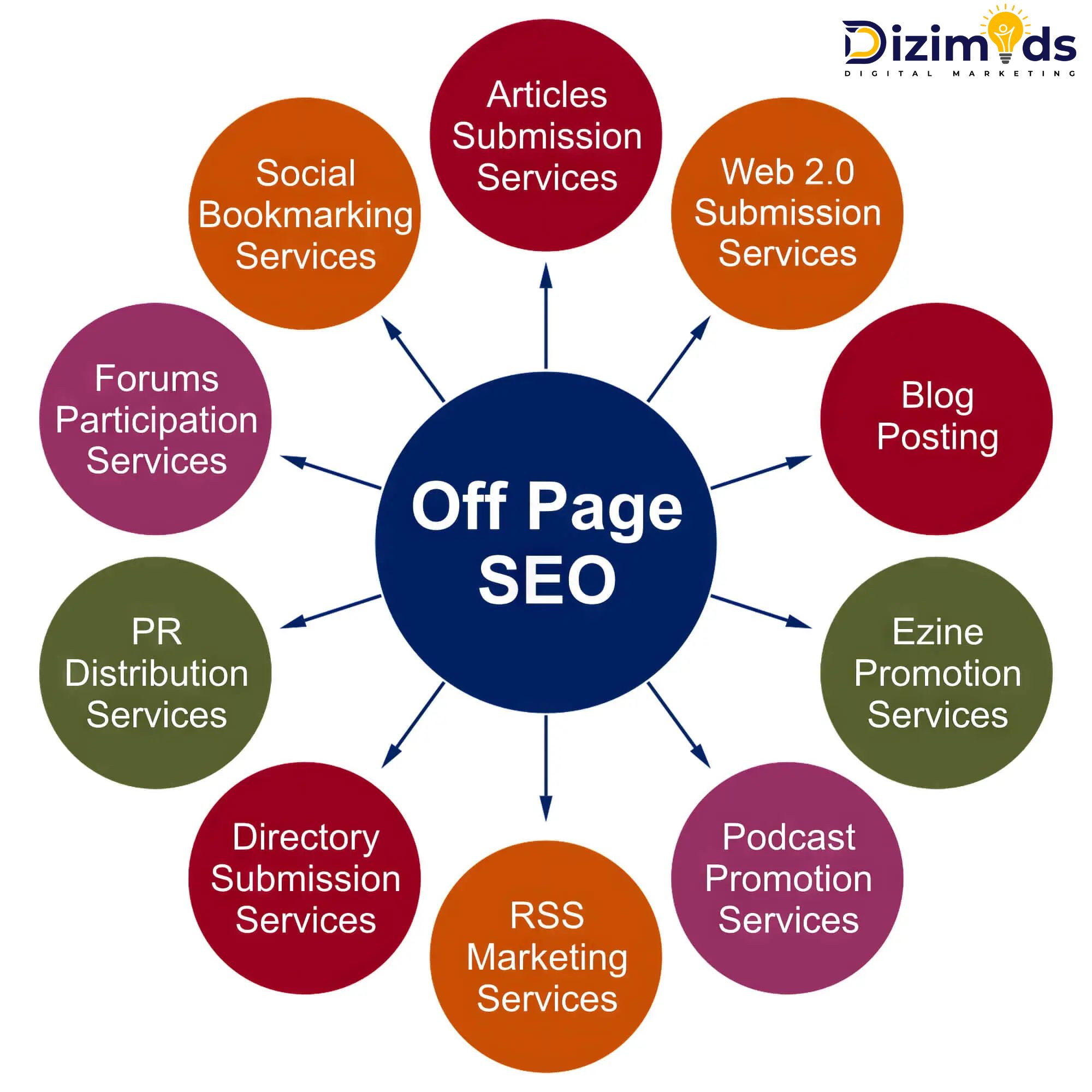
Key Techniques in Off-Page SEO
The primary goal of off-page SEO is to enhance your site’s trustworthiness, authority and overall credibility, both for search engines and users. When executed effectively, it can significantly impact your site’s visibility and ranking.
Here are some of the key techniques in off-page SEO that can help improve your site’s authority and search engine rankings:
- Guest Blogging
Guest blogging is one of the most effective off-page SEO techniques that help acquire backlinks to your website. In guest blogging, you can write an article or a blog post for another website and embed a backlink to your site in the content. This allows users to navigate to your website without any hurdles and improves your credibility and visibility.
- H.A.R.O (Help a Reporter Out)
H.A.R.O stands for Help a Reporter Out. It is an online service that connects media members and reporters, which allows them to gather quotes to create articles, blogs or press releases and engage credible sources. Responding to the reporters’ and journalists’ queries in H.A.R.O can help you gain media exposure and acquire high-value backlinks to improve your site authority and rankings.
- Competitor Analysis
Competitor analysis refers to the practice of analyzing the SEO tactics of your competitors to optimize your own strategy. It allows you to know what keywords your competition is using, what kind of content they are publishing and from where they are getting backlinks to improve their search engine rankings.
- Paid Advertising
Paid advertisements involve publishing ads on other websites and search engines to garner visibility, drive more traffic and generate quality leads for your business.
- Press Release Distribution
A press release or distribution is an official statement sent to the media for publicity. Sharing press releases with media outlets can get you featured on high-traffic websites, secure backlinks and drive more prospects. Regular distribution of press releases is an excellent way to develop your brand and boost your online reputation.
- Building Brand Signals
Brand signals in SEO improve a website’s visibility and reputation through various activities such as online directory listings, social media engagement or mentions on other authoritative websites. They are used by Google as a ranking factor when determining a brand’s authority and trustworthiness.
3. Technical SEO
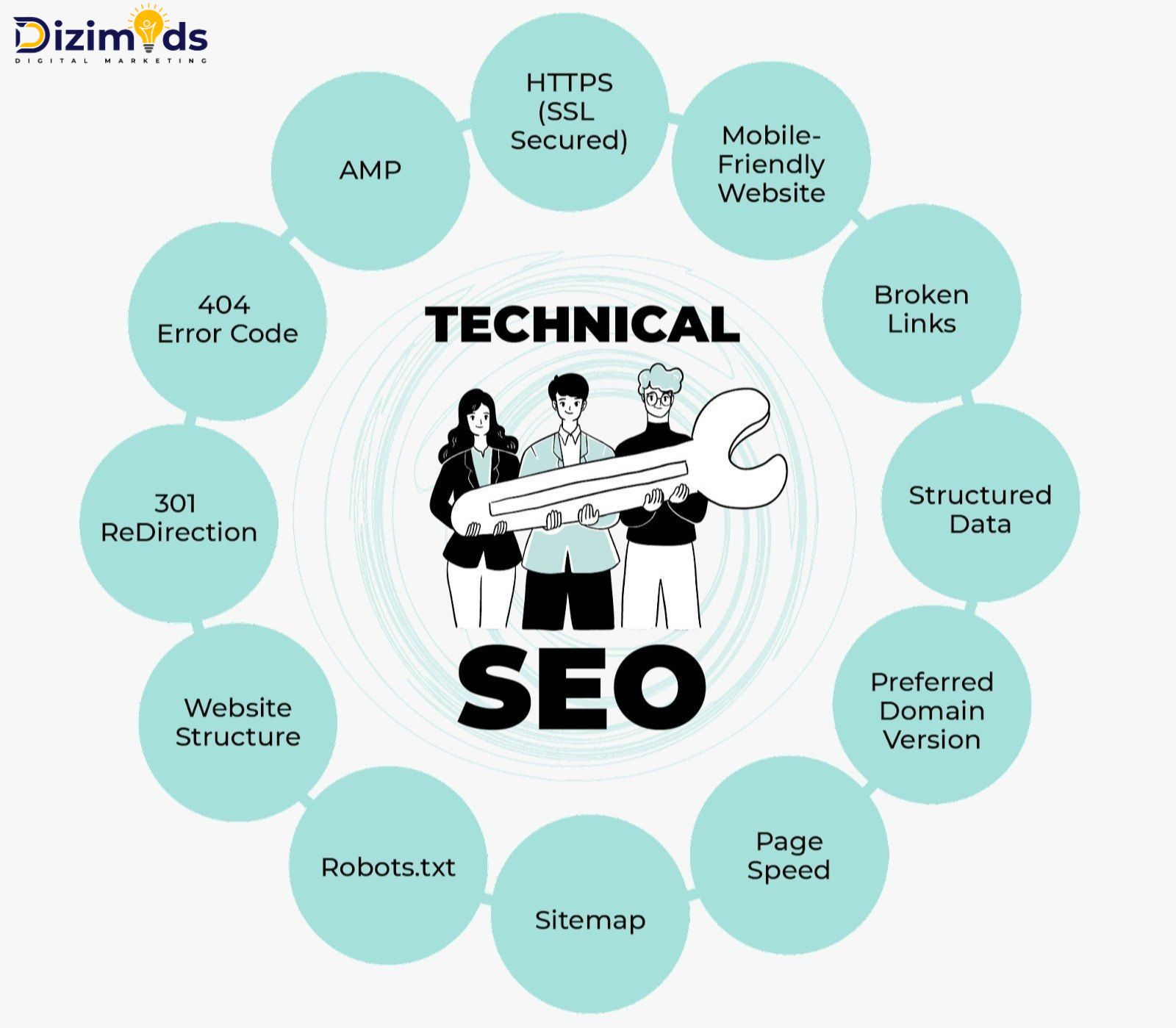
Technical SEO involves the behind-the-scenes actions you take to help search engines crawl, index and understand your website better. Unlike On-Page SEO, which focuses on content and Off-Page SEO, which is about building authority, Technical SEO ensures that your site’s structure and functionality are optimized for search engines. This includes things like improving page speed, making your site mobile-friendly, fixing broken links and ensuring search engines can easily navigate your site.
Essential Aspects of Technical SEO
By optimizing technical elements, you make it easier for search engines to crawl, index and rank your site while also ensuring a seamless user experience. Key techniques in technical SEO include improving page speed, ensuring mobile-friendliness, configuring your robots.txt file correctly and much more. These efforts contribute to better crawling and indexing, ultimately boosting your site’s performance and ranking.
Here’s a deeper look into what technical SEO involves:
- Improving Site Load Speed
The faster a web page loads, the higher it is placed in search engine rankings. Page speed is the time taken for the content of a web page to load. Optimization of site loading speed is the practice of improving the speed of a website’s pages which helps in grabbing higher rankings in SERPs and offering a better user experience.
- Mobile-Friendliness
Mobile-friendliness refers to the process of improving the structure and functionality of a website for mobile devices and tablets. It helps in making your website responsive to multiple screen sizes, easy to navigate on smartphones and improving its load time to enhance user experience.
- Crawl Error Identification
Identification of crawl errors is one of the most crucial steps to improve your site rankings and its overall visibility. The process helps in finding and solving the errors to make a site’s content easily accessible to search engines. The errors can be missing pages, broken links, etc., that hamper a site’s rankings.
- Audit of Keyword Cannibalization
Keyword cannibalization means that multiple articles and blog posts on a website compete and rank for similar keywords or rankings in search engine results. This can happen when the pages have similar keywords or content. Auditing keyword cannibalization is, therefore, a process that allows identifying and optimizing the issues of keyword cannibalization to improve a site’s rankings.
- Audit of Duplicate Content
Duplicate content is content that is closely identical or even a word-to-word match of the content on other pages on the web. It can hamper a website’s search engine rankings and trustworthiness. By auditing duplicate content, you can identify the same content on different URLs and optimize your site content for improved rankings.
- Structuring Your Site
A clean and well-structured website is one of the keys to optimizing user experience and improving search engine visibility. Hence, improving site structure can help you create a clean and organized website that is easy to understand for both users and search engines.
4. Local SEO
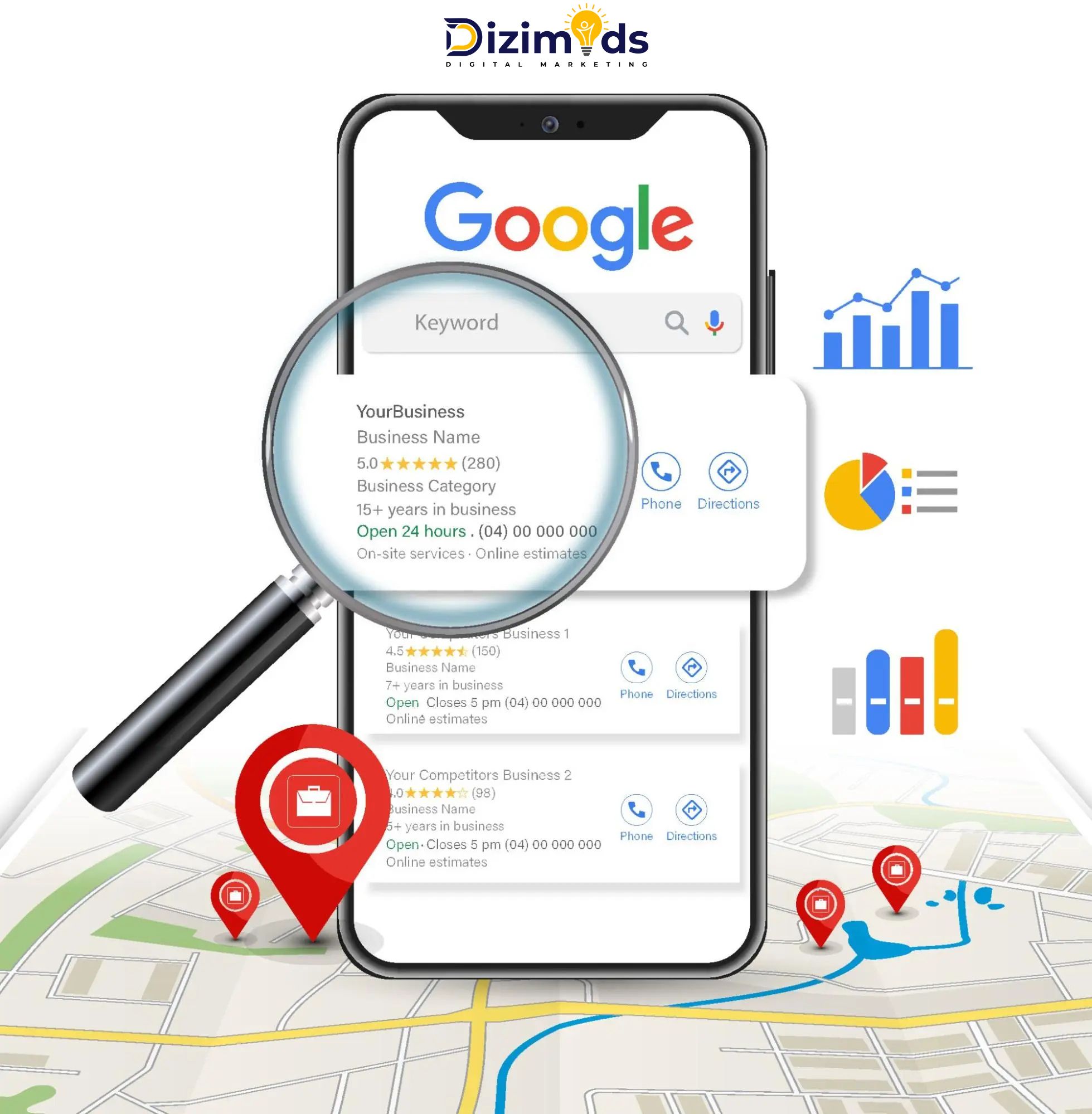
Local SEO is the process of optimizing your website to help it show up in local search results. It’s especially important for businesses that serve specific areas or locations. When someone searches for products or services near them, Local SEO helps your business appear on search engines, like Google and on maps. This can include optimizing your Google My Business profile, getting local reviews and ensuring your business information is consistent across the web.
Benefits of Local SEO for Businesses
Local SEO can transform how your business attracts nearby customers. Here’s why it’s so beneficial:
- Increased Visibility: By optimizing for local searches, your business can appear when potential customers search for products or services in your area.
- Higher Conversion Rates: People searching locally are more likely to visit your store or contact your business for services, leading to higher conversion rates.
- Enhanced Trust and Credibility: Positive local reviews and mentions building trust, making your business more appealing to nearby customers.
- Competitive Advantage: With proper Local SEO, your business stands out against competitors who may not be optimizing for local searches.
Ultimately, Local SEO helps you target the right audience at the right time, boosting both online presence and in-person sales.
5. E-commerce SEO
Ecommerce SEO is the process of optimizing an online store to rank higher in search engine results, attract more organic traffic and ultimately increase sales. It involves improving product pages, category pages and the overall structure of the site to make it more search-engine friendly. By focusing on the right keywords, optimizing images, improving site speed and ensuring a smooth user experience, e-commerce SEO helps your store stand out from the competition and reach customers who are actively searching for products like yours.
Optimizing SEO for Online Stores
Optimizing SEO for your online store is key to growing your business and driving traffic. Here’s how it benefits your store:
- Boosts Search Engine Rankings: A well-optimized store is more likely to rank higher in search engine results, making it easier for potential customers to find you.
- Attracts More Targeted Traffic: By using the right keywords, you attract visitors who are actively looking for products like yours, increasing the chances of sales.
- Improves Site Performance: SEO helps improve the speed and usability of your online store, leading to a better customer experience and fewer abandoned carts.
- Drives Long-Term Growth: Consistent SEO efforts can create a sustainable flow of organic traffic, reducing your reliance on paid advertising.
In essence, optimizing SEO for online stores ensures your site is discoverable, functional and ready to turn visitors into loyal customers.
6. YouTube SEO
YouTube SEO is exactly what it sounds like. YouTube is one of the most used search engines in the world. The trick to gaining views on YouTube goes beyond creating good videos. There are a lot of elements involved in publishing content on YouTube that alerts the algorithms about various things. YouTube SEO involves enriching the metadata of the video, optimizing YouTube channels, SEO-friendly video descriptions, creating attractive thumbnails and enriching them with metadata and much more.
Best Practices for Video SEO on YouTube
Optimizing your YouTube videos is crucial for improving their visibility and ranking on the platform. Here are some key best practices to follow:
- Optimize Titles & Descriptions: Include relevant keywords in the title and write a detailed, keyword-rich description to help YouTube’s algorithm understand the content and its relevance.
- Use Meta Tags & Hashtags: Add relevant meta tags and hashtags to enhance your video’s discoverability and boost its ranking.
- Create Engaging Thumbnails: A compelling thumbnail increases click-through rates, helping your video stand out in search results and recommendations.
- Encourage User Engagement: Prompt viewers to like, comment and share your video. Higher engagement signals to YouTube that your video is valuable, improving its ranking.
- Utilize Closed Captions: Adding closed captions helps YouTube better understand your video’s content and makes it accessible to a broader audience.
By applying these strategies, you can improve your video’s performance and reach a wider audience on YouTube.
7. International SEO
Expanding SEO Efforts Globally
Expanding your SEO efforts globally can unlock new opportunities for growth and visibility. Here’s why it’s essential:
- Reach Global Audiences: International SEO helps your website appear in search results across different countries, attracting a larger, more diverse audience.
- Cater to Local Needs: By optimizing content for different languages, cultures and regional preferences, you can ensure a better experience for international users.
- Increase Market Share: A global SEO strategy allows you to tap into new markets, boosting your brand’s presence and expanding your customer base.
- Improve Ranking Across Borders: Local search engines often have unique ranking factors. Expanding your SEO efforts helps you adapt to these factors for better visibility.
Expanding globally with SEO efforts ensures that your brand is not only visible but also relevant to customers worldwide.
8. Mobile SEO

The process of optimizing a website for search engines while also ensuring that it is viewable flawlessly on mobile devices like smartphones and tablets is known as mobile SEO. A negative mobile phone experience with a brand can turn off a potential customer for good. This type of SEO is essential because it allows you to reach out to your customers at the right time and in the right place, giving them the best experience possible. Mobile optimization helps you analyze your site’s design, structure, page speed and other significant factors to ensure mobile visitors are not turned away by any point of information.
Enhancing User Experience on Mobile
Improving user experience on mobile is a critical component of Mobile SEO. As more people use smartphones to browse the web, it’s essential that your website provides a seamless and engaging experience across all devices.
- Faster Load Times: Mobile users expect fast-loading pages. Optimizing images, reducing file sizes and improving site speed ensures that visitors stay engaged.
- Responsive Design: A mobile-friendly design adapts to any screen size, making it easier for users to navigate your site without frustration.
- Intuitive Navigation: Simplifying menus and making it easy for users to find what they need on mobile devices enhances their experience and reduces bounce rates.
- Improved Content Layout: Displaying content in a clean, readable format on mobile devices ensures that users can quickly access information without zooming or scrolling excessively.
By enhancing mobile user experience, you make sure your site is accessible, user-friendly and likely to rank higher in search results, leading to better engagement and higher conversions.
9. Voice SEO
Voice search is becoming increasingly popular as more users rely on virtual assistants like Siri, Google Assistant and Alexa to perform searches. Optimizing for voice search involves tailoring your content to match how people naturally speak when they ask questions verbally. This means using conversational language, answering specific questions directly and targeting long-tail keywords that reflect how users phrase their queries. To optimize for voice search, focus on creating content that provides concise, relevant answers and incorporates natural language patterns. This approach helps improve your website’s visibility in voice search results and aligns with user intent more effectively.
Adapting Content for Voice Search
Voice search queries are more conversational and context-specific than text searches. To adapt your content, focus on crafting clear, direct answers using natural language and long-tail keywords. Avoid jargon and structure content to provide concise, relevant information. Here are some tips:
- Use Natural Language: Structure content in a way that aligns with conversational speech.
- Incorporate Long-Tail Keywords: Use phrases that people commonly ask in voice searches.
- Provide Clear Answers: Directly answer common voice search queries to satisfy user intent.
- Enhance Readability: Use bullet points or numbered lists to break down complex information and make it easy to digest.
By tailoring your content for voice search, you improve your chances of ranking well and providing a better user experience.
SEO Techniques
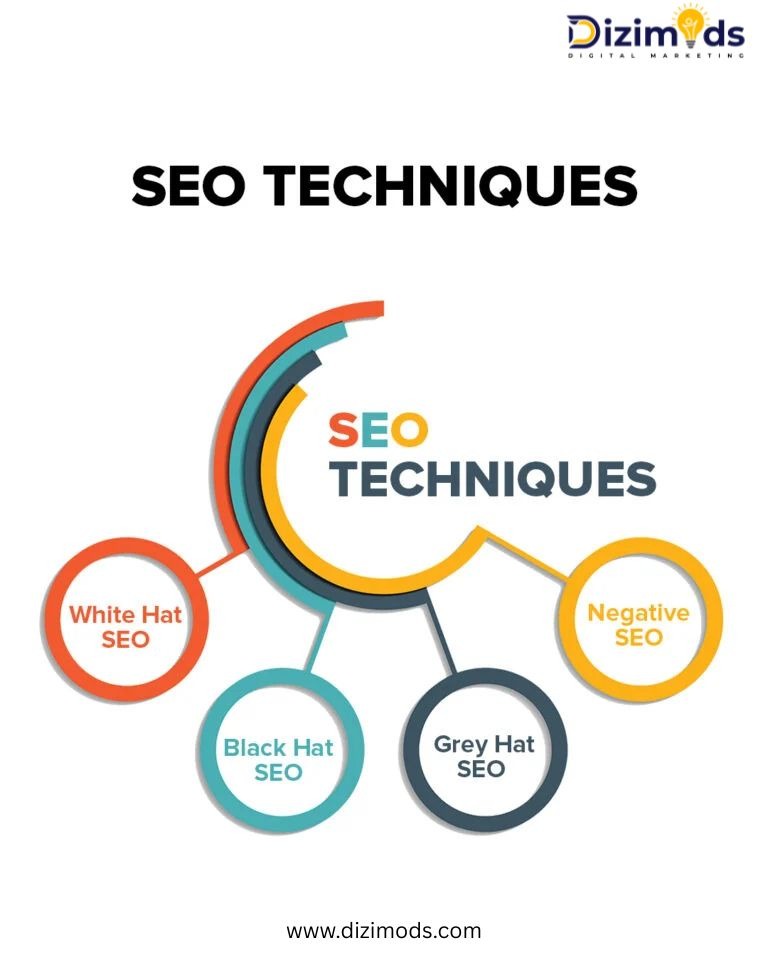
| SEO Techniques | Description |
| White-Hat SEO | Refers to all the optimization techniques which abides by Google’s Search Engine Guidelines. |
| Black-Hat SEO | This is the exact opposite of white-hat SEO in that it finds and takes advantage of any loopholes or weaknesses in Google’s search algorithm to rank better on its SERPs. |
| Grey-Hat SEO | It is often used by SEO agencies due to pressure to see quick results from a client and fall in between white and black hat SEO in terms of approach. |
| Negative SEO | This is done with the intention of making your competitor’s search rankings suffer so that you yourself can take their place or benefit from it. |
1. White-Hat SEO
2. Black-Hat SEO
Black-hat SEO is the exact opposite of white-hat SEO in that it finds and takes advantage of any loopholes or weaknesses in Google’s search algorithm to rank better on its SERP. It does not stick to the search engine’s list of SEO dos and don’ts and resorts to spammy or paid link building methods, keyword stuffing, showing different content to bots/crawlers and humans (called cloaking), etc. to get ahead. It goes without saying that black-hat SEO can get your site blacklisted or its rankings to drop so it is best avoided. Besides, these high-risk best SEO company in Chandigarh techniques give you only short-lived results. Here in this video, Matt Cutts explained how a website can compete using White Hat Techniques rather than using Black Hat Techniques.
3. Grey-Hat SEO
4. Negative SEO
Content and Specialized SEO Types
Content SEO
If you have been haphazardly producing content, hoping that some of it will rank, it’s time to commit to a more organized content SEO strategy. Content SEO works best when the content is high-quality and optimized to rank high in search engines. It will attract search engine traffic and efficiently achieve the targets. The overall goal of content SEO is to create SEO-friendly content that search engines understand while satisfying the user’s intent and keeping them happy. When it comes to content SEO, it’s important to remember that optimizing your existing content develops a strategy that fits best for you.
Read More:
Social Media SEO
Social Media SEO is the practice of optimizing your social media profiles and content to improve your visibility and ranking in search engines. While social media signals like likes, shares and comments don’t directly impact rankings, the content you post can influence your search engine performance in other ways. By creating engaging, shareable content, including relevant keywords and building a strong social media presence, you can drive traffic to your website and improve your brand’s overall online visibility.
Image SEO
Image SEO is the process of optimizing visual content, such as images, to make them more discoverable by search engines. By using relevant keywords in file names, alt text and descriptions and ensuring that images are properly tagged and indexed, you can boost your site’s SEO Company in Chandigarh. Additionally, optimizing images for fast loading speeds enhances the user experience and increases the likelihood of them appearing in image search results.
Video SEO
Frequently Asked Questions on Types of SEO
The different types of SEO include:
- On-Page SEO: Optimizing content and website structure.
- Off-Page SEO: Building backlinks and external authority.
- Technical SEO: Improving site speed, mobile-friendliness, and crawlability.
- Local SEO: Targeting location-based searches.
- E-commerce SEO: Optimizing online stores for better product visibility.
- YouTube SEO: Enhancing video content for search ranking.
- International SEO: Expanding SEO efforts globally.
- Mobile SEO: Optimizing for mobile devices.
- Voice SEO: Optimizing for voice search with conversational keywords.
- Content SEO: Creating valuable, keyword-rich content.
- Social Media SEO: Boosting SEO with social media content.
- Image SEO: Improving image discoverability through proper optimization.
- Video SEO: Enhancing video search visibility with strategic optimization.
Yes, you can perform SEO on your own. Here’s how you can get started:
- Start with analytics by using tools such as Google Analytics, Google Tag Master and Google Search Console to track your site’s visibility and traffic flow
- Audit your website with appropriate tools to identify issues with crawling, on-page factors, indexing and more
- Research and target keywords that are relevant to your audience
- Optimize your site content
- Optimize internal linking
- Acquire backlinks
- Track your rankings, conversion rates and return on investment
The foundation of the SEO process rests on three Cs – content, code and credibility. Let’s explore these building blocks for different types of SEO.
- Content: Search engine spiders can only read text, not images or videos. To boost search engine visibility, include keyword-rich HTML text on key pages. Focus on adding keywords in Titles, Meta descriptions and content and highlight vital terms by bolding, underlining or italicizing them.
- Code: The website’s code impacts its functionality and SEO. Avoid programming languages that are difficult for spiders to read and follow web standards to ensure better design and understanding.
- Credibility: Even with great content and optimized code, your site might not rank high without credibility. To stand out, acquire backlinks from reputable industry sites that rank well for your target keywords.
This concise version maintains all the key pointers while making it more to the point. Let me know if you’d like any further changes!
The three main categories of SEO are:
- On-Page SEO: Optimizing website content and structure for search engines.
- Off-Page SEO: Building external credibility through backlinks and social signals.
- Technical SEO: Improving the website’s technical aspects, such as site speed, crawlability and mobile-friendliness, to enhance search engine rankings.
The four stages of SEO are:
- Planning: Research keywords, audience and competition to create a strategy.
- On-Page Optimization: Optimizing website content, meta tags and structure for search engines.
- Off-Page Optimization: Building backlinks and improving online presence through external channels.
- Monitoring & Analysis: Tracking performance, analyzing results and making adjustments to improve rankings over time.
White-Hat SEO refers to ethical SEO practices that follow search engine guidelines, focusing on creating quality content, proper keyword usage and building genuine backlinks. These techniques aim for long-term, sustainable results.
Black-Hat SEO involves unethical practices that manipulate search engine algorithms, such as keyword stuffing, cloaking and using low-quality backlinks. While these techniques may yield quick results, they can lead to penalties or being banned by search engines in the long run.