
Table of Contents
If you’ve ever wondered why some websites consistently rank on the first page of Google while others struggle to gain visibility, one of the biggest reasons is link building.
Search engines use backlinks as a signal of trust and authority. When reputable websites link to your content, Google sees it as a vote of confidence. The more high-quality and relevant backlinks your website earns, the stronger its authority becomes.
However, link building in 2026 is very different from what it was a decade ago. Buying links, using spammy directories, or creating hundreds of low-quality backlinks no longer works. In fact, these outdated practices can harm your website’s rankings.
Today’s successful link-building strategy focuses on earning relevant, authoritative, and natural backlinks that provide real value to users.
In this guide, you’ll learn what link building is, why it’s important, the different types of backlinks, proven link-building techniques, common mistakes to avoid, and how to build a sustainable backlink profile that supports long-term SEO growth.
What Is Link Building?

Link building is the process of acquiring hyperlinks from other websites that point to your website. These hyperlinks, commonly known as backlinks, help search engines discover new pages and evaluate the credibility of your content.
Think of every quality backlink as a recommendation. If a trusted website links to your article, product page, or service page, it sends a positive signal to search engines that your content is useful and trustworthy.
For example, if an industry blog publishes an article about “Technical SEO” and includes a link to your in-depth guide, that backlink can contribute to improving your search visibility.
The goal of link building is not simply to increase the number of backlinks but to earn links from websites that are relevant, authoritative, and trusted within your industry.
Why Is Link Building Important for SEO?

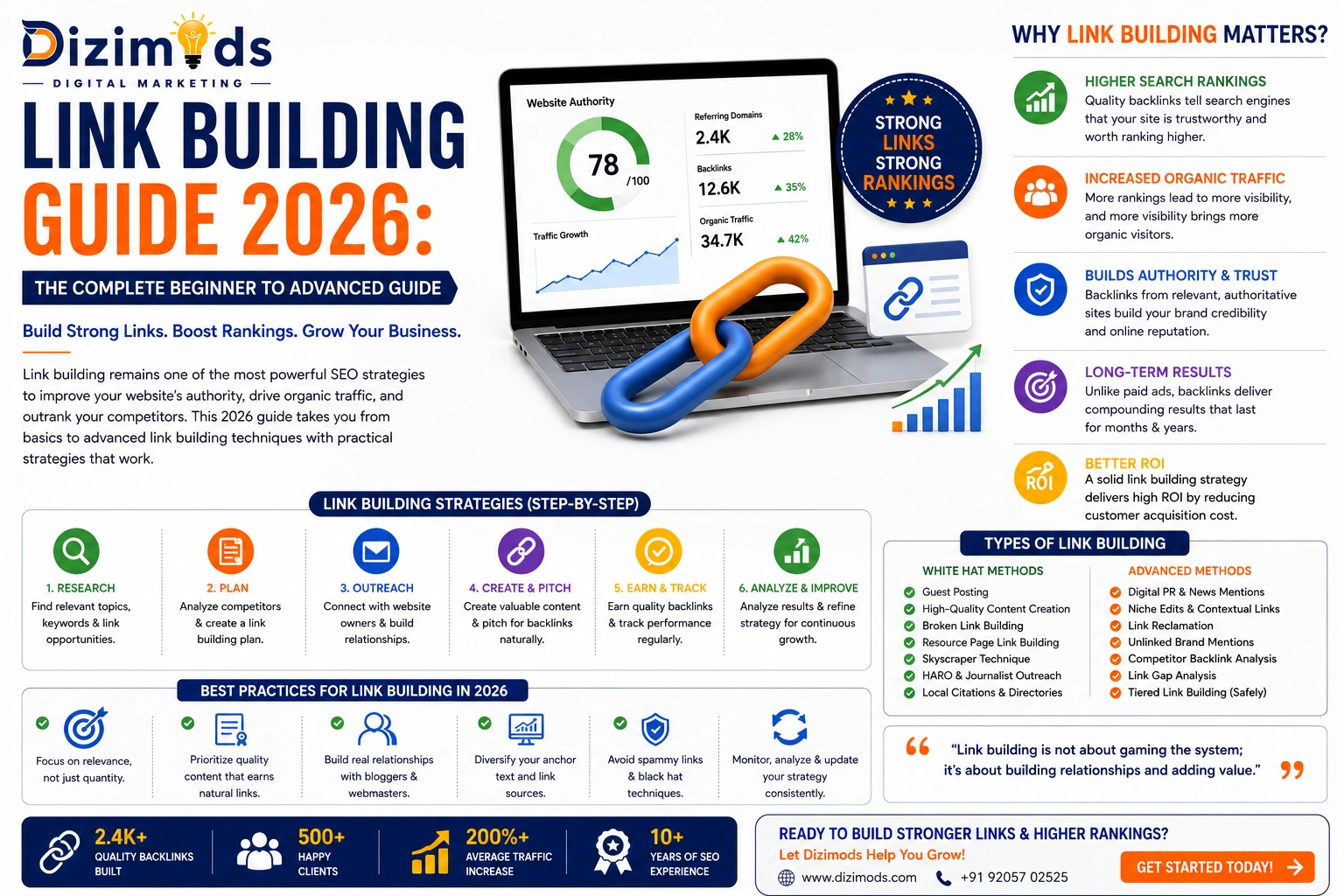
Google considers backlinks one of the strongest ranking signals because they help determine the authority and credibility of a website.
A well-planned link-building strategy can provide several long-term benefits.
Improve Search Engine Rankings
High-quality backlinks increase your website’s authority, making it easier for important pages to rank for competitive keywords.
Increase Organic Traffic
Backlinks from relevant websites not only improve rankings but also bring referral traffic from users who click those links.
Build Website Authority
As your backlink profile grows with links from trusted websites, your domain becomes more authoritative in the eyes of both search engines and users.
Faster Content Discovery
Search engine bots often discover new pages through links from other websites, helping fresh content get indexed more efficiently.
Strengthen Brand Trust
Being mentioned or linked to by respected industry websites enhances your brand’s credibility and positions your business as a trusted source of information.
Read More Blog: Ecommerce SEO The Complete Guide
Types of Backlinks

Not all backlinks carry the same SEO value. Understanding the different types of backlinks helps you focus on quality rather than quantity.
Editorial Backlinks
Editorial backlinks are earned naturally when another website references your content because it provides genuine value.
These are considered the most valuable type of backlink because they are not requested or purchased—they are earned through high-quality content.
Guest Post Backlinks
Guest posting involves writing informative articles for relevant websites in exchange for a contextual backlink.
When done on reputable websites with useful content, guest posting remains one of the most effective white-hat link-building techniques.
Business Directory Links
Listing your business on trusted online directories helps improve brand visibility and supports local SEO.
Focus only on reputable and niche-specific directories instead of submitting your website to hundreds of low-quality listings.
Resource Page Links
Many websites maintain resource pages that recommend useful tools, guides, or educational content.
If your article genuinely adds value, reaching out to these website owners can help you earn high-quality backlinks.
Broken Link Building
Broken link building involves identifying broken links on other websites and suggesting your relevant content as a replacement.
This strategy benefits both website owners and your SEO because it helps them fix dead links while earning you a quality backlink.
Digital PR Links
Digital PR focuses on creating newsworthy content, industry research, reports, or unique insights that journalists and publishers naturally reference.
These backlinks often come from high-authority websites and can significantly strengthen your backlink profile.
Read More Blog: Shopify SEO Guide
White Hat vs Black Hat Link Building

Not every link-building strategy is safe. Understanding the difference between ethical and manipulative techniques is essential.
White Hat Link Building
White-hat strategies follow Google’s guidelines and focus on earning backlinks through quality content and genuine relationships.
Examples include:
- Guest blogging
- Digital PR
- Resource page outreach
- Original research
- High-value content
- Industry collaborations
These methods support sustainable SEO growth.
Black Hat Link Building
Black-hat techniques attempt to manipulate rankings through unnatural backlinks.
Examples include:
- Buying backlinks
- Private Blog Networks (PBNs)
- Link farms
- Automated link-building software
- Spam comments
- Excessive directory submissions
These practices can lead to Google penalties and should be avoided.
Key Takeaways
By now, you should understand that successful link building isn’t about collecting thousands of backlinks—it’s about earning links that are relevant, trustworthy, and beneficial for users.
A few high-quality backlinks from authoritative websites are often more valuable than hundreds of low-quality links from unrelated sources.
Read More Blog: Local SEO Checklist
Proven Link Building Strategies (2026)
Building backlinks has evolved significantly over the years. In 2026, Google’s algorithms focus more on relevance, authority, and content quality than on the number of links pointing to your website.
Instead of chasing hundreds of backlinks, successful businesses focus on earning links that genuinely add value and strengthen their online reputation.
Below are some of the most effective link-building strategies that continue to deliver long-term SEO results.
1. Create Link-Worthy Content

The foundation of every successful link-building campaign is valuable content.
People naturally link to content that solves problems, provides original insights, or explains complex topics in a simple way.
Examples include:
- Ultimate guides
- Industry case studies
- Original research
- Statistics pages
- Infographics
- Step-by-step tutorials
- Free SEO tools
- Checklists
High-quality content continues attracting backlinks long after it’s published.
2. Guest Posting on Relevant Websites

Guest posting remains one of the safest white-hat link-building strategies.
Instead of publishing articles on random websites, focus on industry-relevant blogs with genuine traffic and strong editorial standards.
When writing guest posts:
- Choose relevant websites.
- Provide unique content.
- Add value to readers.
- Include one natural contextual backlink.
- Avoid keyword stuffing.
Quality always matters more than quantity.
3. Broken Link Building

Many websites unknowingly contain broken outbound links.
This creates an opportunity to earn backlinks.
The process is simple:
- Find broken links on relevant websites.
- Create or identify similar content on your website.
- Contact the website owner.
- Suggest replacing the broken link with your resource.
Since you’re helping improve their website, this outreach often receives positive responses.
4. Resource Page Outreach

Thousands of websites maintain resource pages recommending useful articles, tools, and guides.
If your content genuinely deserves inclusion, reaching out to website owners can result in high-authority backlinks.
Examples include:
- SEO Resources
- Marketing Resources
- Business Tools
- Startup Guides
- Educational Resources
5. Digital PR

Digital PR focuses on creating content that journalists and publishers naturally reference.
Examples include:
- Industry reports
- Surveys
- Original data
- Company research
- Expert opinions
- Market trends
These campaigns often generate backlinks from highly authoritative news and industry websites.
6. Competitor Backlink Analysis

One of the easiest ways to discover backlink opportunities is by analyzing competitors.
Review:
- Which websites link to competitors
- Guest post opportunities
- Resource pages
- Industry directories
- Blog mentions
If a website links to your competitors, there’s a good chance they may also consider linking to your content.
7. HARO and Expert Contributions
Journalists regularly seek expert insights for articles.
By contributing valuable responses, you can earn backlinks from trusted publications.
Focus on providing:
- Original opinions
- Practical examples
- Industry expertise
- Well-researched answers
These backlinks often carry significant authority.
8. Local Citation Building

For local businesses, citations are an important part of link building.
Ensure your business is listed consistently across trusted directories with accurate:
- Business Name
- Address
- Phone Number
- Website
- Business Category
This improves both local SEO and brand credibility.
9. Link Reclamation
Sometimes websites mention your business without linking to it.
Monitor online mentions and politely request that the website add a backlink to your homepage or relevant content.
Since they already mention your brand, these requests usually have a higher success rate than cold outreach.
Read More Blog: Technical SEO Guide 2026
Anchor Text Best Practices

Anchor text tells search engines what the linked page is about.
A healthy backlink profile includes a natural mix of anchor texts.
Good examples include:
- Brand Name
- Website URL
- Generic phrases such as “Learn More”
- Partial keyword matches
- Natural contextual phrases
Avoid repeatedly using the exact same keyword as anchor text, as this can appear manipulative.
Read More Blog: What is Amazon A+ Content
How to Evaluate Backlink Quality

Not every backlink helps your AI SEO.
Before pursuing a backlink, ask yourself:
- Is the website relevant to my niche?
- Does it have genuine organic traffic?
- Is the content high quality?
- Is the backlink placed naturally within the content?
- Would users actually click on this link?
A single backlink from a trusted industry website is often more valuable than dozens of low-quality links.
Read More Blog: What is SEO
Common Link Building Mistakes

Many websites struggle to improve rankings because they rely on outdated tactics.
Avoid these common mistakes:
- Buying backlinks
- Participating in link exchange schemes
- Using Private Blog Networks (PBNs)
- Submitting to low-quality directories
- Automating backlink creation
- Building links from irrelevant websites
- Over-optimizing anchor text
- Ignoring backlink quality
Building links naturally takes time, but it delivers long-term and sustainable e-commerce SEO results.
Best Link Building Tools

The right tools make backlink research and outreach much easier.
Some of the most widely used tools include:
- Ahrefs
- SEMrush
- Google Search Console
- Screaming Frog SEO Spider
- BuzzStream
- Hunter.io
- Moz Link Explorer
- Majestic SEO
These tools help identify backlink opportunities, analyze competitors, monitor lost links, and track your backlink profile over time.
Conclusion

Link building is no longer about collecting as many backlinks as possible—it’s about earning trust. A successful backlink strategy focuses on creating valuable content, building genuine industry relationships, and acquiring relevant links from authoritative websites.
When combined with strong technical SEO, quality content, and a positive user experience, ethical link building can significantly improve your website’s visibility, rankings, and organic traffic over time.
Grow Your Website Authority with Dizimods
At Dizimods, we help businesses build sustainable SEO strategies through ethical, white-hat link-building practices. Our team focuses on earning high-quality backlinks from relevant websites, improving domain authority, strengthening organic visibility, and supporting long-term business growth.
Whether you’re running an eCommerce store, a local business, or a corporate website, a well-planned link-building strategy can make a measurable difference in your search performance.
Frequently Asked Questions (FAQs)
Result-Driven SEO Agency Backed by Experience
Built for brands that want long-term growth – not shortcuts.