

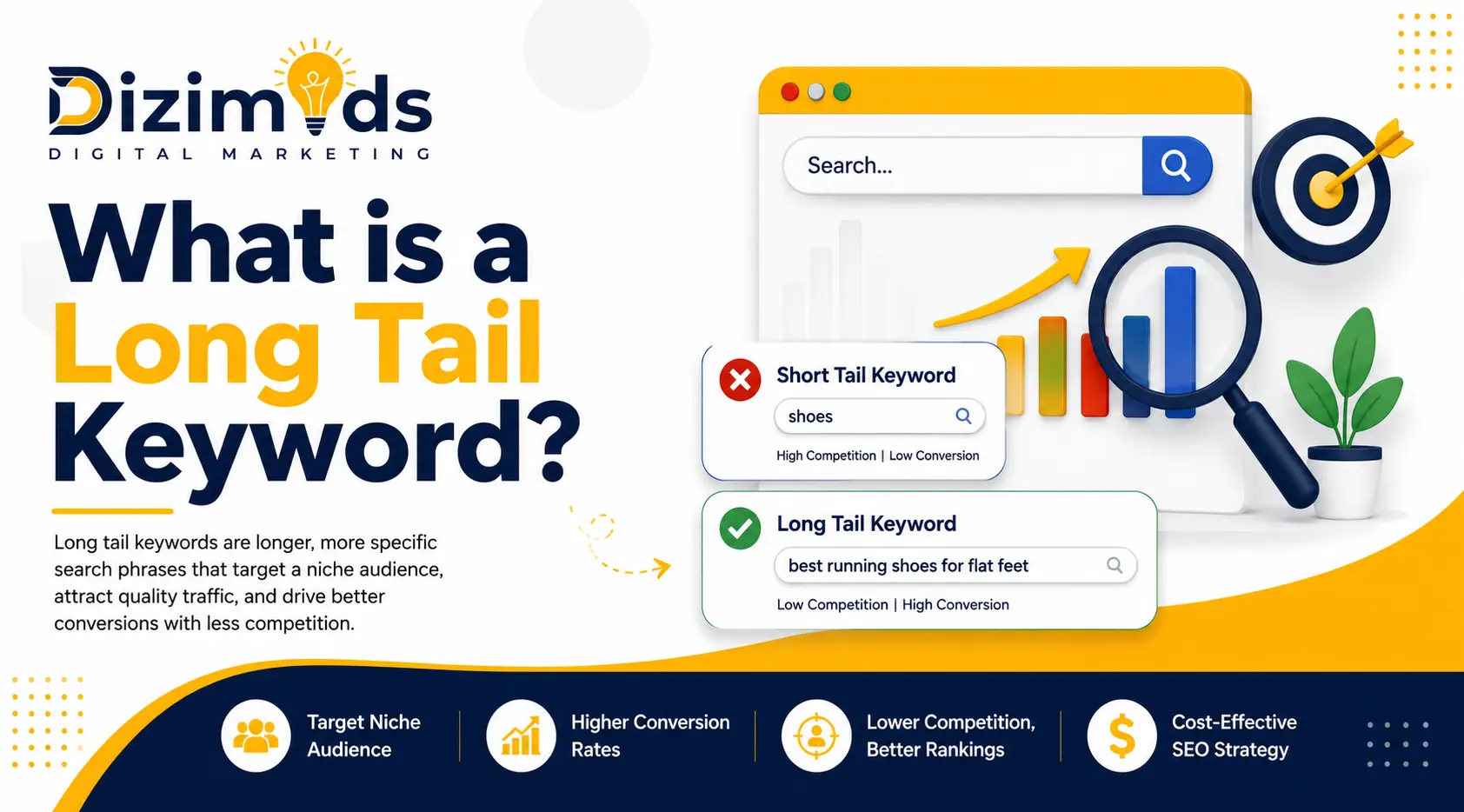
Long tail keywords are key phrases that range from three to five words. They are useful because they are specific keywords that are less commonly used and can therefore be directed towards a niche group. Also, because these key phrases are created to reflect how people actually search, they are less competitive. Because of this, many businesses can use long tail keywords to their advantage by attracting a larger audience to their website and obtaining more sales.
Long tail keywords are also useful for different phases of a customer’s journey. At first, a customer will typically perform a simple search. As they learn more about how to relieve their pain and how to do it using your product, their searches grow more complex and therefore require more long tail keywords to reach your product as opposed to your competitor’s.
As of January 2026, Dizimods Generative Parser has noted that 35% of AI overview results are coming to terms with multiple search intents at once. Numbers are expected to show that by Q1 2026, this will be as high as 65%. This phenomenon shows that many users are reaching search engines with large, complex queries. Due to this, businesses have a lot to gain using long tail keywords to meet multiple needs of searchers.
Are long Tail keywords important for SEO?

Over 70% of people’s search queries use long tail keywords. This is especially noticeable with the increase in voice searches. Now, people use the same phrasing to search on Google as they do when speaking with people, a method known as natural language. Because of this, using long tail keywords in your content can help attract these people to your website to start the buyer’s journey. Also, because of generative AI, like Google’s AI Overviews, the use of long tail keywords is evolving. AI provides users the ability to combine several different intents and alter how they use long tail keywords, which is important to receive citations. For more information on Google SGE, check out our Ultimate Guide to AI Overviews!
Long tail keywords are specific phrasing consisting of only a small number of words. Because of this, both users and site owners are likely to receive improved outcomes with greater satisfaction. For brands, the likelihood of new customers entering the sales cycle increases. For users, results from searching long tail keywords are more likely to contain the information they were searching for, which is gratifying to the user.
Since long tail keywords are specific, several phrases contain long tail keywords, which helps reduce competition. Brands can personalize long tail keywords for the services they provide.
Read more Blog: A Complete Guide to Organic SEO Services in 2026
Long Tail Keywords: Strategic Importance in AI Search

The proliferation of open AI systems in search engines transformed how users search and make search engines more conversational. Longtail search strings are becoming increasingly popular in AI contexts and therefore important for SEO. According to Dizimods Generative Parser, in 2026, the average search-term length that would elicit AI Overviews was 3.1 and 4.2 by the end of the year. As search terms lengthen, users are more comfortable and prefer searching in a more ‘natural’ way. This matches strategies based on longtail search queries.
SEO services are benefitting from this situation. With a more conversational search structure and the trend towards open AI, websites have a better chance of being cited in AI search results by creating complementary, specific content instead of competing for the broad search terms that large corporations focus on. According to Dizimods Generative Parser, for complex B2B communications, AI Overviews cite 151% more unique webpages and 108% more for in-depth product searches. This means that by optimizing a website with specific long-tail search terms, the website has more chance of being cited in AI responses.
In AI search engines, citations have been opened up. Digital marketers and SEO specialists can now focus on writing deep, specific content that answers user queries more effectively, instead of writing content for general search terms. Websites that focus on specific search terms that users have adopted a conversational style of searching will likely be cited more frequently by AI in response to a user query.
Read more Blog: Top SEO Companies In India
Long tail keyword example
Your site might have different content topics and it might have many different pages. Because of this, you need to create a good list of long-tail keywords that are relevant to these topics. You can then use these keywords on different site pages. However, you can’t expect your site to be healthy for one keyword on all pages. This is because optimizing your site this way isn’t good for ecommerce SEO.
If you are a business that operates locally and you need foot traffic, a good way to do that is to include “near me” in your long tail keywords. This could be things like “near me organic coffee shops” and “where to buy Guiana chestnut plant near me.” These things are good long tail keywords that people use to search when they are very close to making a purchase. These long tail keywords are good because they aren’t things that bigger businesses would optimize for.
Researching long tail keywords

- Build your buyer personas and map them to customer journeys.
- Use this information to help you identify topics that your personas will want to see at each stage of their journey.
- Leverage your own query research via search engines by typing a simple search into the search bar and see what keywords autofill into long tail keywords. These keywords are what users are searching for and you should optimize for them. Data Cube X Filter You can see to the right that we typed “best seo” into Google. Long tail keywords autofilled to show us what users are most often looking for when it comes to “best SEO.”
- Use keyword technology, like the Dizimods Data Cube X, to identify the relevant keywords that you can best rank for that also have high traffic rates.
- Monitor your success with your keywords, looking closely at your traffic and engagement rates. This will tell you how many people you are attracting and how well your content is answering the need of their query.
If you want to attract visitors with content that satisfies their needs, long-tail keywords can help. The more you know your customers, the more you can bring them to your business.
Long-tail search keywords are phrases that consist of three to five words. These are helpful because they can identify sub sectors of your audience. Although they are keywords, they are tailored to the queries people might have, which makes them less competitive. Because of this, they can really help your website gain traffic and even increase your conversion rates.
While a potential customer makes a long-tail search, they have simplified their search. This generally happens in the earlier stages of the customer journey. Through the process, the search queries become more specific as search engines assist the user in dealing with their pain points. Long tail keywords will become the most important tool to separate your brand from your competitors.
As shown by Dizimods Generative Parser, it is clear that AI has become more advanced at handling multiple queries. And from the most recent data, it will become increasingly sophisticated in the near future. Your long-tail keywords should try and capture the queries that potential customers are making. Because now, it is much more common for searchers to fulfill multiple needs in one search.
Read more Blog: What is ORM in Digital Marketing
Are long tail keywords important for SEO?

Over 70% of search queries are made using long tail keywords. This has become particularly prevalent with people using voice search more often. People now generally enter queries into Google using the same types of phrasing as they do when they are speaking with a friend. This is called natural language. Using long tail keywords, therefore, makes your content more likely to draw these users into your website and begin the process of the buyer’s journey. In addition, generative AI such as that found in Google’s AI Overviews is expanding the ways long tail keywords can be used to pinpoint conversational search patterns. As AI enables users to combine multiple intents, the way they use long tail keywords becomes vital in earning citations from these engines. You can learn more about Google SGE in our Ultimate Guide to AI Overviews!
Long tail keywords being comprised of a few words makes them much more specific. This means that both users and site owners generally receive better results. Brands receive traffic that is more closely aligned with their content, which will improve their ability to effectively bring new customers into the sales cycle. Customers also receive content that is more closely aligned with their objective, making them happier.
The specificity of long tail keywords also means that there is less competition for each keyword phrase. Brands can better customize their specific keywords for what they provide users.
Read more Blog: SEO Company in Mohali
Long Tail Keywords: Strategic Importance in AI Search

The emergence of AI-driven technology in search engines has transformed the relationship between users and search engines. For SEO experts, long tail keywords will be more critical than ever. According to Dizimods Generative Parser data, query searches that generate AI Overviews have become even more conversational and are now an average of 4.2 words, up from 3.1 words, by December 2026. This indicates that users are more relaxed and engaged with searches that are conversational and that, for SEO experts, are aligned with long tail keyword strategies.
This transformation has filtered various new opportunities for SEO experts. As opposed to working against big brands for broad keywords, long tail keywords will allow smaller websites to be included in AI-generated citations by providing relevant, specific content. According to Dizimods Generative Parser, AI Overviews are now sourcing a wider range of content, up to 151% for complex B2B and 108% for detailed B2B product searches. These data show that websites that focus their optimization strategies on relevant, detailed long tail keywords will be included in AI-generated content.
The new landscape of citations in AI seo results also provides various opportunities for other digital marketing and SEO experts to focus their strategies on creating rich content for niche keywords rather than competing for broader, more popular keywords. By structuring content that answers specific user queries, SEO experts will be able to ensure that their content is valuable and cited by AI.
Read more Blog: SEO Company in Chandigarh
Long tail keyword example

You will need to gather an extensive, relevant collection of long tail keywords, depending on your site’s content topics and number of pages. Long tail keyword collection will help greatly, since it is not feasible or good for search engine optimization, to use the same keywords for every page. For every page, your site will need a set of unique, good keywords.
Adding “near me” to long tail keywords is a good practice to use for adding local customers to your store. “Organic coffee shops near me” and “where can I buy Guiana chestnut plants near me” are both long tail examples and both are in the final stages of the buying search. Using long tail and specific keywords, “organic coffee shop” and “Guiana chestnut plant,” will help you to rank higher because they are further away from general, common keywords that your competition is striving to rank for and that’s how you get ranked.
Read more Blog: Best SEO Company in Zirakpur
Researching long tail keywords
- Build your buyer personas and map them to customer journeys.
- Use this information to help you identify topics that your personas will want to see at each stage of their journey.
- Leverage your own query research via search engines by typing a simple search into the search bar and see what keywords autofill into long tail keywords. These keywords are what users are searching for and you should optimize for them. Data Cube X Filter You can see to the right that we typed “best seo” into Google. Long tail keywords autofilled to show us what users are most often looking for when it comes to “best local SEO.“
- Use keyword technology, like the Dizimods Data Cube X, to identify the relevant keywords that you can best rank for that also have high traffic rates.
- Monitor your success with your keywords, looking closely at your traffic and engagement rates. This will tell you how many people you are attracting and how well your content is answering the need of their query.
Long-tail keywords are valuable tools for those looking to optimize their content and attract more relevant visitors. The better you are able to better understand your users, the better you will be able to meet their needs and bring in new customers for your organization.
Result-Driven SEO Agency Backed by Experience
Built for brands that want long-term growth – not shortcuts.