In just a few years, the internet has profoundly changed the processes of product discovery, research and purchase. Selling products in physical stores is a think of the past; now, millions of competing websites draw the attention of customers in the digital realm. Dizimods empowers businesses with tools needed to succeed in the digital marketplace with the combination of our effective SEO and digital marketing services.
With shopping online being the new trend, customers use websites to make purchase decisions. Since a large majority of the internet traffic comes from search engines, having a prominent search position is vital. Dizimods assists brands in being present when customers look for particular products or services online.
Marketers need to be able to adjust to the constant evolution of trends and consumer habits driven by the smart, new AI features of search engines. At Dizimods, we equip businesses with an edge against competition through a deep understanding of how search engines evaluate websites and modern SEO techniques. Achieving visibility in search engines is directly correlated with the marketer’s ability to implement advanced techniques while remaining informed on the underlying principles of search engine design.
What is a Search Engine?
Searching the internet for information has been made easy with the help of search engines. Say a word or a phrase and immediately, websites that relate the most will pop up. Algorithms that break down the web and organize it, then match site contents to words or phrases and create a list of links for users are called search engines. Search engines have two sections:
Search Index: Pages that search engines break down and organize are kept in the search index.
Not just text pages are organized, other content like graphics, videos, keywords, headings, images and metadata are also kept. Indexed pages also change with the help of bots that are sent to websites to search for new content strategy.
If no one has indexed your pages on Google, then no one will see them.
Search Algorithm: Search engines also have a brain and for search engines, this is called the search algorithm. This is where rules and formulas which help decide which pages should show first in the results are set.
Algorithms rely on content relevance to the words or phrases searched, the freshness of the content, the loading and the mobile view of the pages, links to other pages and domain authority.
Trustworthy answers that are relevant to a questions are what most users want and search engines like Google have a lot of these.
These search engines also have updated algorithms that help eliminate spam, showing users that the site is worth using.
Related Services: Amazon Review Services
The Diverse World of Search Engines: Types and Functions

Search engines are synonymous with Google for a significant number of people around the world. Google may account for almost 90% of the searches done worldwide, but there exist several alternatives, other types of search engines, in 2026 that cater for a variety of needs.
Traditional Search Engines |
Vertical or Search Specific Engines |
AI Powered Search Engines |
Google, Bing and Yahoo are all these search engines that are considered traditional that crawl and index billions of web pages. They deliver results in the form of websites, images, news and videos. | Unlike traditional engines, these also focus on a specific type of search or niche, such as Amazon for product searches, YouTube for video searches, Pinterest for visual and lifestyle inspirations and LinkedIn for professional networking. | With the rise of AI, the searching mechanism has thoroughly shifted to ChatGPT, Perplexity AI, Bing Copilot and Google Gemini for all multimodal answers using text, image and video. |
How Search Engines Work (Step-by-Step)

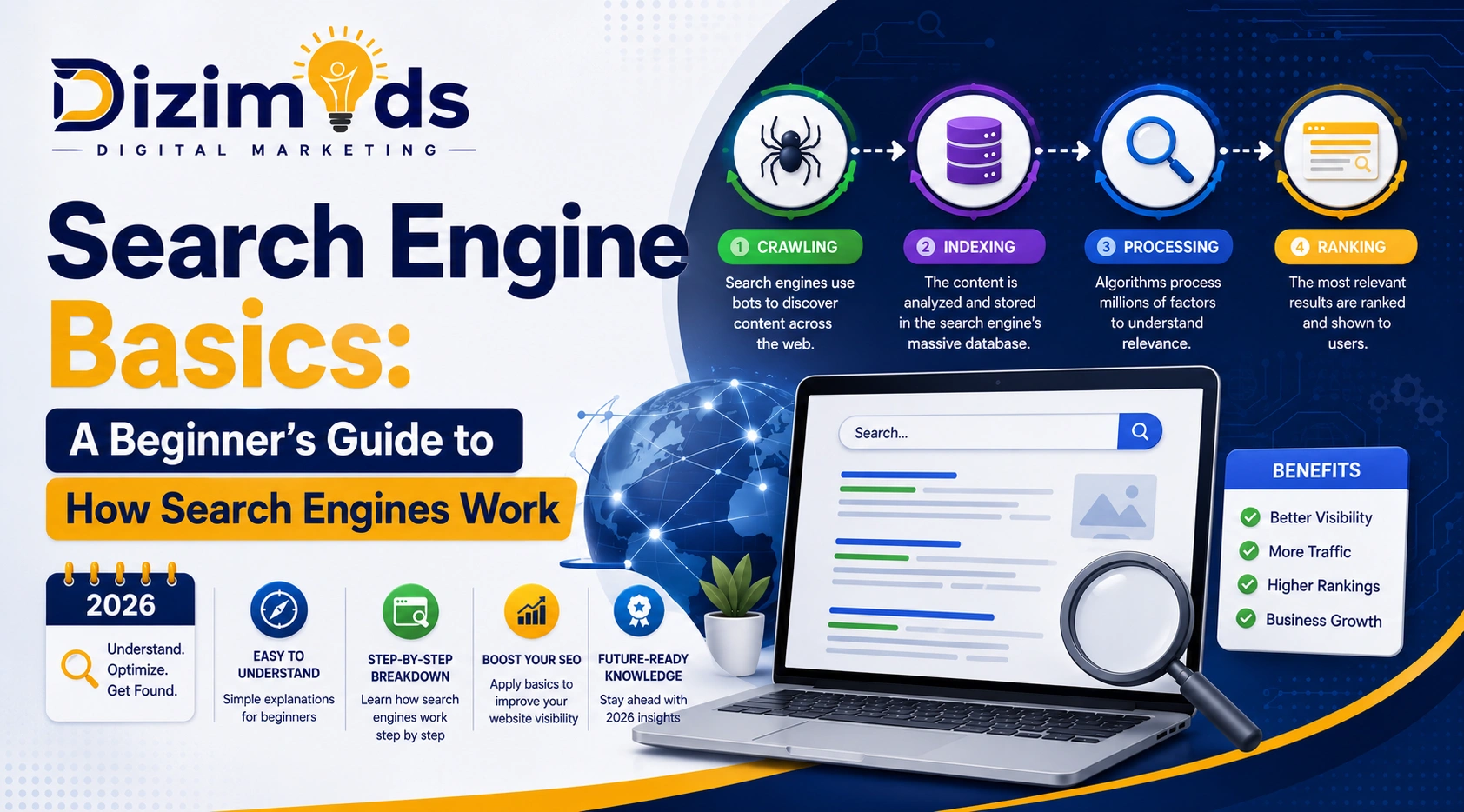
The search engine has a systematic way to score your website and provide information to users. This consists of three processes: crawling, indexing and ranking.
1. Crawling
An automated program, generally known as a crawler, spider or Googlebot, is used by search engines to browse the internet. These programs can travel from page to page by following links, reading sitemaps and using manual descriptions.
Crawlers can read the HTML, text, images and links of web pages.
2. Indexing
3. Ranking
Once a user has input data into the search engine, the algorithms that process data attempt to index it and score businesses based on rank and quality. There are more than 200 different factors for a score that can be based on many things, including keywords, the quality of content, the backlinks that are provided, the speed of the page and how user friendly the page is.
The search engine results page (SERP) contains all of these final scores, in addition to links, featured snippets, maps, images, videos and AI responses that will be offered in the year 2026.
Related Services: Google Reviews services
Search Engines Key Ranking Factors in 2026

Each element in SEO is most important in varying degrees and aspects for newcomers. Tackling some of the pressures that exist in SEO in 2026 is inevitable. You should consider the following.
1. Backlinks (Quality > Quantity)
Google regards backlinks as an important signal. Backlinks are important for businesses as they allow them to build credibility and authority for their website. This time instead of targeting hundreds of random clicks, backlinks need to be requested from a few trustworthy and reputable websites that relate to and reflect the nature of the business.
2. Relevance (Keywords + Semantic Search + User Intent)
Google no longer analyzes searches just on the basis of Keywords. Now it is a bit more advanced and it focuses on Semantic Searches, whereby Google is able to understand requests, associated terminology and the context in which things are being searched. If some people searched ‘cheap whatsapp marketing services’, Google will most likely give a response that includes ‘affordable digital marketing services’.
3. Content Quality (Helpful Content + EEAT)
Google has stated that it is now more concerned with the EEAT and helpful content as opposed to content that is heavily keyword search engine optimized. Google is now much more interested in content that places an emphasis on the experience of the author as well as on service and content trust and authority.
4. Up-to-Date Information (Trending Topics)
5. Page Experience (Speed, Mobile, UX)
6. Personalization of Results
If you believe that all users get the same search result, you are mistaken. Search results are personalized based on the user and their current locations. Some of the personalization of the search results deals with the local searches, putting nearby businesses first. The mobile user gets the search results that are most relevant to them with the least effort. There are also previous search results that impact the current searches.
Related Services: Flipkart Review Services
Changes in Search Engines to Expect in 2026 and Beyond

Searching online for a list of links is a thing of the past. Search engines are utilizing knowledge systems and AI to create systems that can comprehend emotions, context and intent drives queries. Here are some of the more prominent examples of the evolution of search engines in 2026 and beyond.
Advanced AI in Search Engines
The introduction of multimodal Gemini has completely overturned the way information is displayed on search engines. This is due to its ability to generate results that require in-depth analysis and context, deep searches and comprehension of text, images, videos and even computer code. What is more, Google has created a model that can analyze and comprehend information from different formats and languages in a way that is unified and complete. Similar in function to the technologies mentioned above, ChatGPT, Perplexity and Bing Copilot are examples of conversational artificial intelligence that enable users to pose complex queries and, in turn, provide direct answers.
Growth of Zero-Click Searches and AI Snapshots
With Google search engine results pages (SERP), users can complete queries without having to click on links. This is made possible through knowledge panels, featured snippets and overviews. As a result of these advancements, users are presented with a complete answer and prompted to perform a search, thus eliminating the need to explore multiple sources.
Search Becomes Hyper Personal
Now, search results factor in more than just your search history. Results are personalized based on your geolocation, your device, your digital behavioral patterns and even your language and culture. Search results can adapt behaviorally, linguistically and culturally.
Content Helpfulness & Authority
Google’s helpful content update (HCU) aims to judge content more on its accuracy and usefulness rather than on keywords. As part of the EEAT principle, Google learns from first-hand experiences, case studies and reviews rather than regurgitates content.
Read More Blog: Best Meesho Review Service to Increase Seller Ratings
Growth of MultiModal and Voice Search
Smart devices like Alexa, Siri and Google Assistant have popularized voice searches, which are becoming more and more common. Searches are becoming less formal and more natural. Users can search using text, images or a combination of the two.
Impending Challenges and Opportunities for Businesses

Search engines are becoming more powerful day by day. This presents a new array of challenges to businesses, but gold is there for the taking for those who adapt.
Challenges
Zero-Click Results Mean Less Website Traffic
Recent AI developments like AI snapshots and feature snippets give users direct answers, removing the need to click on any website. This all but eliminates brand and organic traffic.
Saturation of AI-Generated Content
The internet is filled with AI-generated text. This makes it increasingly more likely that search engines will curate text based on the highest level of expertise, insights and authoritativeness.
Constant Change in Algorithms
Business must be ready for more change as Google and other search engines fine-tune their procedures to handle spam updates and as search engines in general prioritize their own procedures more and more.
Rising Competition
Technical Demands
SEO can no longer be a focus of a business without the adequate technical means. Businesses are going to be losing website traffic (and customers) more and more as web vitals and other advanced website optimization tools (like schema markups) become the new standard.
Read More Blog: Flipkart Review Service Provider: How to Boost Seller Ratings Fast
Opportunities
Authority Development
The business must first have authority and expertise in the field if they wish to dominate the industry.
Local SEO Growth
Voice & Visual Search Optimization
Content Innovation
The combination of human and AI creates a unique and engaging experience.
User Centric SEO
Businesses have identified a focus on web development as being the critical point for success. Especially optimization with a focus on the mobile experience.
Conclusion
The 2026 search engine marks a new era of AI-discovery systems that provide instant, contextual answers rather than simple digitized listings. As this technology advances, Dizimods helps businesses compete using the trust, credibility and value of SEO. As we see the rise of AI, we help businesses create long-term value.
The never-ending crawl and index of the search engine has changed the way we access and consume information. Due to the prevalence of AI-based, instant, zero-click search results, being seen throughout the Internet is more competitive than ever. Dizimods overcomes this with user-prioritized, content-driven, search-intent SEO stratagies and voice and visual search integrations. Businesses that can adapt, discoverability and authoroty.
Result-Driven SEO Agency Backed by Experience
Built for brands that want long-term growth – not shortcuts.