
Table of Contents
If your website isn’t appearing on Google’s first page, the issue isn’t always backlinks or advertising. In many cases, the biggest problem is poor on-page SEO.
Even if your website has excellent products or services, Google needs clear signals to understand what each page is about. That’s exactly where on-page SEO plays a critical role.
On-page SEO focuses on optimizing every element within your webpage—from titles and headings to content, images, internal links, and user experience. When implemented correctly, it helps search engines crawl, understand, and rank your pages more effectively while also improving the experience for visitors.
In this guide, you’ll learn what on-page SEO is, why it’s important, and the best practices to optimize your website for higher rankings and more organic traffic.
Read More Blog: Link Building Guide 2026
What is On-Page SEO?

On-page SEO is the process of optimizing individual web pages so they rank higher in search engines and provide a better experience for users.
Unlike off-page SEO, which focuses on backlinks and external signals, on-page SEO involves improving the content and HTML elements directly on your website.
These include:
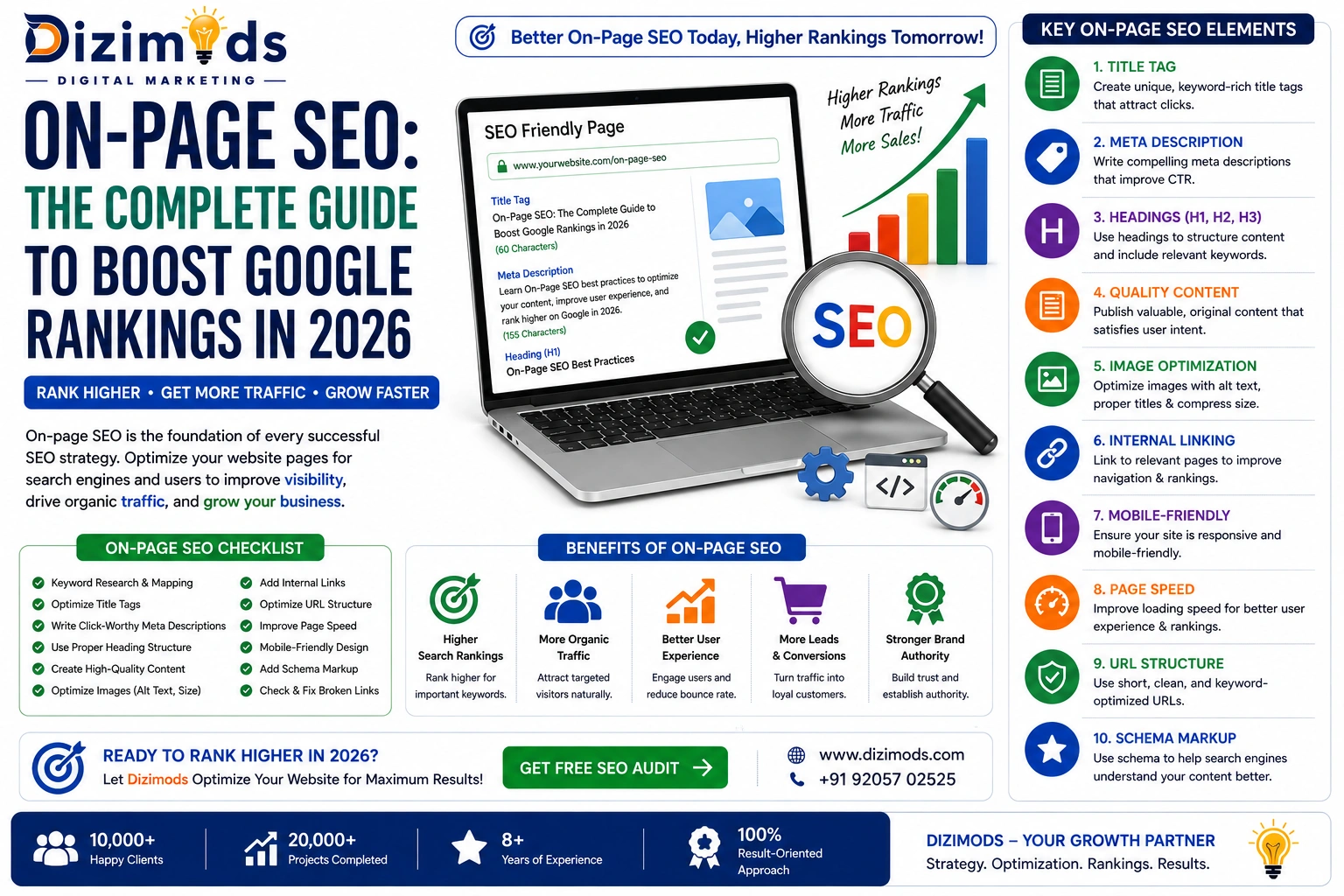
- Page Titles
- Meta Descriptions
- URL Structure
- Heading Tags (H1–H6)
- Keyword Placement
- Internal Linking
- Image Optimization
- Content Quality
- Schema Markup
- Mobile Friendliness
- Page Speed
- User Experience
When all these elements work together, search engines can better understand your content, making it easier to rank for relevant keywords.
Read More Blog: What is Amazon A+ Content?
Why is On-Page SEO Important?

Google’s goal is to provide users with the most relevant, helpful, and trustworthy results.
If your page is well-optimized, it becomes easier for Google to determine:
- What your page is about
- Which keywords it should rank for
- Whether it satisfies user intent
- How valuable it is compared to competing pages
Good on-page SEO also improves:
- Organic traffic
- User engagement
- Click-through rate (CTR)
- Average session duration
- Conversion rate
- Crawlability and indexing
- Overall website quality
Without proper on-page SEO, even high-quality websites may struggle to achieve strong search rankings.
Read More Blog: Ecommerce SEO Complete Guide
Benefits of On-Page SEO
Implementing effective on-page SEO offers several long-term benefits for businesses and website owners.
Improves Google Rankings
Increases Organic Traffic
As your rankings improve, more users can discover your website through unpaid search results, reducing your reliance on paid advertising.
Enhances User Experience
A clean layout, organized headings, fast loading speed, and easy navigation help visitors quickly find the information they need, encouraging them to stay on your site longer.
Higher Click-Through Rate (CTR)
Better Content Relevance
Supports Conversion Goals
Whether your goal is lead generation, online sales, or inquiries, optimized content can guide visitors toward taking meaningful actions.
Read More Blog: Local SEO Checklist
Core Elements of On-Page SEO

1. SEO-Friendly Title Tag

The title tag is one of the most important ranking factors.
A strong title should:
- Include the primary keyword
- Be engaging and descriptive
- Stay within 50–60 characters
- Clearly explain the page topic
Example:
On-Page SEO Guide: 15 Proven Techniques to Improve Google Rankings
Read More Blog: Technical SEO Guide 2026
2. Meta Description

Although meta descriptions are not a direct ranking factor, they influence click-through rates by summarizing your page in search results.
A good meta description should:
- Include the target keyword
- Explain the page value
- Encourage users to click
- Stay between 150–160 characters
Example:
Learn everything about on-page SEO, including optimization techniques, best practices, keyword placement, and strategies to improve your Google rankings in 2026.
3. URL Optimization

A clean, descriptive URL helps both users and search engines understand the page topic.
Good Example
https://www.dizimods.com/on-page-seo-guide/
Avoid
https://www.dizimods.com/page?id=123456
Best practices:
- Keep URLs short
- Use hyphens (-)
- Include the primary keyword
- Avoid unnecessary parameters
4. Heading Tags (H1–H6)

Proper heading structure improves readability and content organization.
Example:
- H1: On-Page SEO Guide
- H2: What is On-Page SEO?
- H2: Benefits of On-Page SEO
- H3: Optimize Title Tags
- H3: Improve Internal Linking
- Only one H1 should appear on each page.
Read More Blog: What is SEO? A Complete Beginner’s Guide
5. Keyword Optimization

Keywords should appear naturally throughout your content.
Recommended placements include:
- Title Tag
- URL
- H1 Heading
- First 100 words
- H2 Headings
- Meta Description
- Image ALT Text
- Conclusion
Avoid keyword stuffing. Write naturally for users first, then optimize for search engines.
6. High-Quality Content

Google prioritizes content that is:
- Original
- Helpful
- Accurate
- Well-structured
- Easy to read
- Comprehensive
- Updated regularly
Focus on solving users’ problems rather than simply inserting keywords.
Read More Blog: WhatsApp Marketing Complete Guide
7. Internal Linking Strategy

Internal linking is one of the most underrated yet powerful on-page SEO techniques. It connects one page of your website to another, helping both users and search engines discover relevant content.
A strong internal linking structure improves website navigation, distributes page authority, and increases the chances of important pages ranking higher.
Benefits of Internal Linking
- Helps Google crawl your website efficiently
- Passes authority between pages
- Increases page views
- Reduces bounce rate
- Improves user experience
- Strengthens topical relevance
Best Practices
- Link to relevant pages naturally.
- Use descriptive anchor text instead of generic phrases like “Click Here.”
- Link to your most important service pages.
- Ensure there are no broken internal links.
- Add links to related blog posts wherever appropriate.
Example Internal Links for Dizimods
8. Image SEO

Images make your content more engaging, but they also need to be optimized for search engines.
Image SEO Checklist
✔ Use descriptive filenames.
Example:
on-page-seo-checklist.webp
instead of
IMG001.webp
✔ Add ALT Text
Example:
On-Page SEO Checklist for Google Rankings
✔ Compress images before uploading.
✔ Use modern formats like WebP.
✔ Implement lazy loading.
✔ Add captions where relevant.
Optimized images improve page speed, accessibility, and visibility in Google Images.
Read More Blog: Top 10 Social Media Marketing Agencies in India
9. Content Optimization
Content is the foundation of successful on-page SEO. Google rewards content that demonstrates expertise, answers user intent, and provides real value.
Tips for Optimized Content
- Write for humans first, search engines second.
- Cover the topic comprehensively.
- Use simple, easy-to-understand language.
- Include examples, statistics, and practical insights where appropriate.
- Update older articles regularly.
- Add FAQs to answer common user questions.
- Break content into short paragraphs and use bullet points.
Long-form, well-structured content generally performs better because it covers topics in greater depth.
10. Page Speed Optimization

- Higher bounce rates
- Lower conversions
- Reduced crawl efficiency
- Poor Core Web Vitals
- Compress images
- Minify CSS, JavaScript, and HTML
- Enable browser caching
- Use a CDN
- Reduce server response time
- Remove unused code
- Optimize fonts
- Limit unnecessary plugins
- Aim for a loading time of under 3 seconds whenever possible.
11. Mobile SEO

With Google’s mobile-first indexing, your website must perform well on smartphones and tablets.
Mobile SEO Best Practices
- Responsive design
- Fast-loading pages
- Readable font sizes
- Proper spacing between buttons
- Mobile-friendly navigation
- Optimized images
- Avoid intrusive pop-ups
A seamless mobile experience helps improve engagement and search performance.
12. Core Web Vitals

Core Web Vitals are performance metrics that measure how users experience your website.
Largest Contentful Paint (LCP)
Measures loading speed.
Ideal: Under 2.5 seconds
Interaction to Next Paint (INP)
Measures responsiveness.
Ideal: Under 200 milliseconds
Cumulative Layout Shift (CLS)
Measures visual stability.
Ideal: Below 0.1
Improving these metrics can enhance both user satisfaction and SEO performance.
13. EEAT for On-Page SEO

Google values content that demonstrates:
- Experience
- Expertise
- Authoritativeness
- Trustworthiness
To strengthen EEAT:
- Publish original content based on real-world experience.
- Clearly identify the author or organization.
- Include contact details and company information.
- Showcase testimonials, case studies, or certifications where relevant.
- Keep content accurate and up to date.
EEAT is especially important for competitive and business-related topics.
Read More Blog: 10 Best SEO Companies in India 2026 Edition
14. Common On-Page SEO Mistakes

Avoid these frequent issues:
- Keyword stuffing
- Duplicate content
- Missing title tags
- Missing meta descriptions
- Multiple H1 tags
- Broken internal links
- Large, uncompressed images
- Thin or low-value content
- Slow-loading pages
- Poor mobile usability
- Missing ALT text
- Ignoring user intent
- Outdated content
Regular SEO audits can help identify and fix these problems.
On-Page SEO Checklist

Before publishing any page, review the following:
Content
- Primary keyword included naturally
- Comprehensive and helpful information
- Original content
- Easy-to-read formatting
- Clear headings
HTML Elements
- Optimized title tag
- Compelling meta description
- SEO-friendly URL
- One H1 tag
- Logical H2 and H3 hierarchy
Images
- Compressed images
- WebP format (where possible)
- Descriptive filenames
- ALT text added
Technical
- Fast loading speed
- Mobile responsive
- HTTPS enabled
- Internal links
- External references (where appropriate)
- XML sitemap updated
- Canonical tag configured (if needed)
Read More Blog: What is Omnichannel E-commerce
Final Thoughts

On-page SEO is not a one-time task—it is an ongoing process of improving your website so that it better serves users and search engines alike.
By optimizing titles, content, headings, images, page speed, mobile usability, internal links, and technical elements, you create pages that are easier to understand, more useful to visitors, and better positioned to earn visibility in search results.
Focus on delivering valuable, user-first content while following SEO best practices. Over time, consistent optimization can contribute to stronger organic visibility, better engagement, and sustainable website growth.
Frequently Asked Questions (FAQs)
Result-Driven SEO Agency Backed by Experience
Built for brands that want long-term growth – not shortcuts.