

Table of Contents
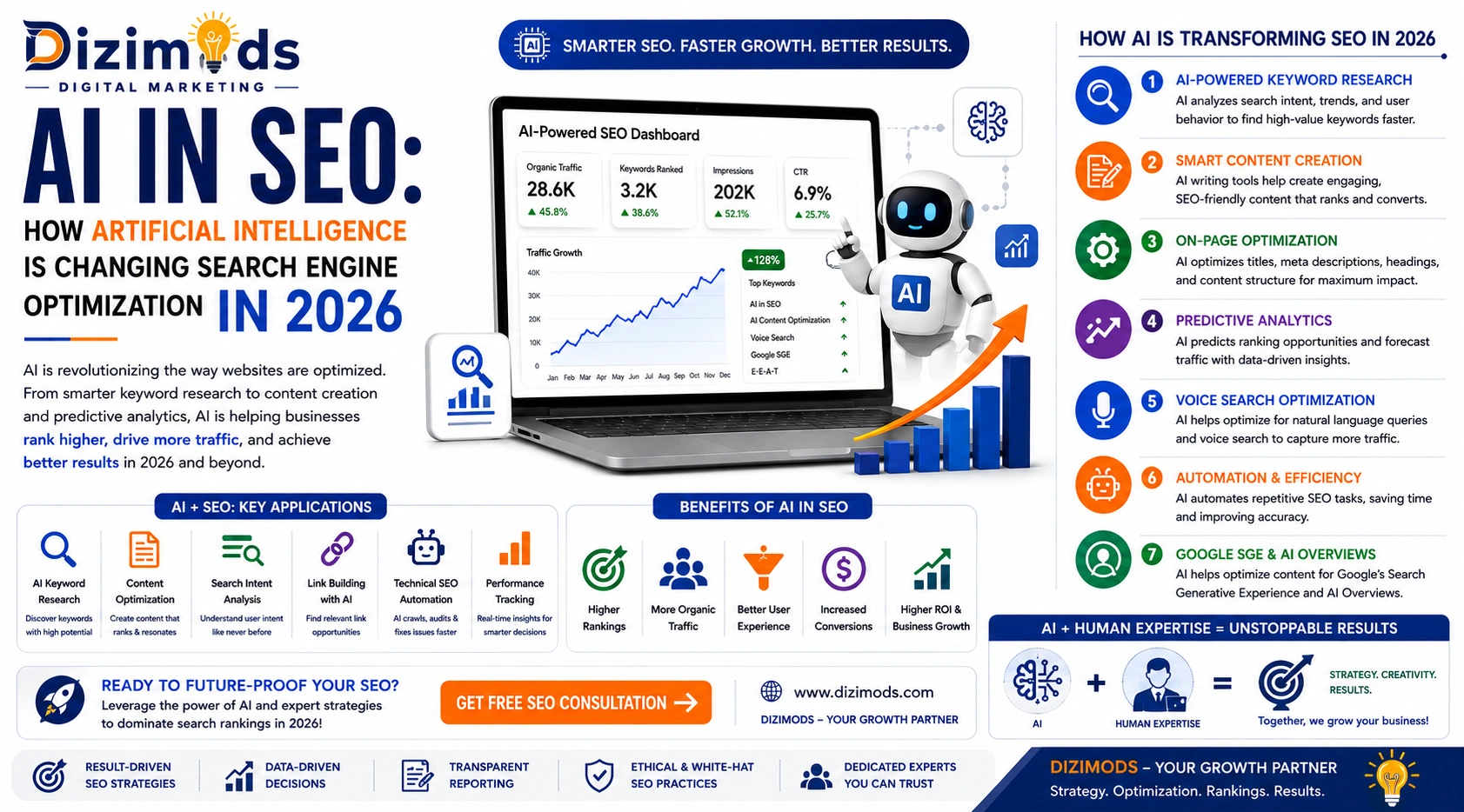
Search engine optimization is no longer limited to manually researching keywords, writing meta tags, building backlinks, and checking rankings every week. The way people search, search engines understand content, and businesses optimize websites is changing rapidly. One of the biggest changes is the growing role of AI in SEO.
Artificial intelligence is helping SEO professionals analyze large amounts of search data, identify content opportunities, understand search intent, optimize existing pages, and automate repetitive SEO tasks. However, AI does not replace SEO strategy or human expertise. The best results come from combining AI-powered tools with real SEO experience, original insights, technical knowledge, and a clear understanding of the target audience.
For businesses competing in Google Search in 2026, understanding AI in SEO is becoming increasingly important.
What Is AI in SEO?

AI in SEO refers to the use of artificial intelligence and machine learning technologies to improve different parts of search engine optimization.
AI can process large amounts of information much faster than a person can manually. In SEO, this can help with tasks such as keyword research, search intent analysis, content optimization, competitor research, technical SEO analysis, internal linking, SERP analysis, and performance monitoring.
Instead of replacing an SEO professional, AI can act as a productivity and research assistant.
For example, an SEO team can use AI to identify keyword variations and content gaps, while an experienced SEO professional can evaluate whether those opportunities actually make sense for the business.
This distinction is important because AI SEO is not simply about generating large amounts of content. Effective SEO still requires strategy, experience, quality control, and useful information for users.
Read Blog: SEO Mistakes to Avoid in 2026
Why Is AI in SEO Important?

The amount of information available on the internet continues to grow, while search behavior is becoming more conversational and specific. Users may search using short keywords, detailed questions, voice queries, or longer conversational prompts.
AI helps SEO professionals understand these different search patterns and work with large datasets more efficiently.
Some important benefits of AI in SEO include:
- Faster keyword research
- Better search intent analysis
- Faster content gap identification
- Content optimization recommendations
- Automated SEO data analysis
- Improved internal linking opportunities
- Faster competitor research
- Technical SEO monitoring
- Better content briefs
- More efficient reporting
AI can reduce the amount of time spent on repetitive tasks, allowing SEO professionals to focus more on strategy, testing, analysis, and business goals.
Read More: Best Amazon Account Management Services Agencies in 2026
How AI Is Changing SEO
AI is affecting almost every major area of modern SEO. However, the most effective approach is not to automate everything. Instead, businesses should identify repetitive tasks where AI can improve efficiency while keeping strategic decisions under human control.
1. AI for Keyword Research

Traditional keyword research can involve collecting thousands of keywords, grouping them by topics, checking search intent, analyzing competitors, and identifying opportunities.
AI can make this process faster.
An AI-powered SEO workflow can help organize keywords into topic clusters and identify related search queries. It can also help SEO professionals understand whether a query is informational, commercial, navigational, or transactional.
For example, instead of targeting only:
“digital marketing agency”
An SEO strategy may also consider related searches such as:
- Digital marketing services
- Digital marketing company
- Online marketing agency
- SEO and digital marketing services
- Digital marketing agency in India
- Best digital marketing company
- Digital marketing services for businesses
The final keyword selection should still be based on actual search data, competition, relevance, business value, and user intent—not simply AI-generated suggestions.
Read Article: Off-Page SEO: The Complete Guide
2. AI and Search Intent

Ranking for a keyword is not enough if the content does not satisfy the reason behind the search.
Search intent helps determine what users actually want when they enter a query.
For example, someone searching for “AI in SEO” may want to:
- Understand what AI in SEO means
- Learn how AI is used in SEO
- Find AI SEO tools
- Understand the benefits of AI SEO
- Learn whether AI can improve Google rankings
- Find an SEO agency that uses AI strategically
AI can help categorize large keyword lists according to potential search intent.
However, human review remains important because the same keyword can sometimes have multiple interpretations.
Read More Article: On-Page SEO: The Complete Guide
3. AI for Content Optimization

AI can assist SEO teams in reviewing existing content and identifying areas that may need improvement.
For example, AI-assisted content analysis can help identify:
- Missing subtopics
- Weak headings
- Keyword variations
- Unclear explanations
- Frequently asked questions
- Content gaps
- Internal linking opportunities
- Areas requiring additional examples
The goal should not be to add keywords everywhere.
Google’s guidance emphasizes creating helpful, reliable, and people-first content rather than content created primarily to manipulate search rankings.
Therefore, AI content optimization should improve usefulness and clarity, not turn a page into a collection of repeated keywords.
View Blog: Google Ranking Factors 2026
4. AI for Technical SEO

Technical SEO involves many repetitive checks, particularly for websites with hundreds or thousands of URLs.
AI can support SEO teams in analyzing technical information and identifying potential issues involving:
- Broken links
- Redirects
- Duplicate content
- Canonical tags
- Indexing problems
- Sitemap issues
- Metadata
- Internal linking
- Page structure
- JavaScript-related issues
- Crawlability
AI can help prioritize problems, but technical SEO decisions should be verified using reliable tools such as Google Search Console, crawling software, analytics platforms, and server-side information where necessary.
AI should support the technical SEO process—not blindly make changes to a live website.
View Article: Link Building Guide 2026
5. AI for Competitor Analysis

Competitor research is another area where AI in SEO can save time.
An SEO professional can collect information about competing websites and use AI to organize the data into useful categories.
For example, businesses can compare:
- Target keywords
- Content topics
- Landing pages
- Content depth
- Internal linking structures
- SERP visibility
- Backlink patterns
- Featured content opportunities
- Local SEO signals
The valuable part is not simply copying what competitors are doing.
A stronger approach is to identify what competitors cover, what they miss, and where your website can provide a more useful experience.
Explore Blog: Ecommerce SEO: The Complete Guide
6. AI and Internal Linking

Internal links help users navigate a website and help search engines understand relationships between pages.
On large websites, finding relevant internal linking opportunities manually can take significant time.
AI can analyze page topics and suggest potentially relevant connections.
For example, a page about SEO services could potentially link to related pages such as:
- Technical SEO Services
- Local SEO Services
- Ecommerce SEO
- Keyword Research
- SEO Audit Services
- Content Marketing
- Google Search Console
The SEO professional should review the suggestions and ensure that every link is genuinely useful to the reader.
Explore Article: Shopify SEO Guide
7. AI for SEO Reporting
SEO reporting often involves collecting data from different platforms and turning it into understandable insights.
AI can help summarize large datasets and highlight changes such as:
- Organic traffic increases or decreases
- Keyword ranking movements
- Click-through-rate changes
- Indexing changes
- Top-performing pages
- Pages losing visibility
- Conversion trends
- Technical issues
However, a good SEO report should explain why something happened, not simply list numbers.
For example, instead of saying:
“Organic traffic decreased by 15%.”
A useful analysis would investigate whether the decrease was caused by ranking changes, seasonality, technical problems, indexing issues, algorithm changes, content decay, or changes in search demand.
Read Now: Local SEO Checklist: The Ultimate Guide
Best AI SEO Tools and Their Uses
There are many AI-powered and AI-assisted tools available for SEO. Different tools are useful for different stages of the SEO process.
Common categories include:
| SEO Activity | How AI Can Help |
| Keyword Research | Discover keyword ideas and topic relationships |
| Content Research | Identify subtopics and content gaps. |
| Content Optimization | Improve structure, clarity, and topical coverage. |
| Technical SEO | Analyze large amounts of website data. |
| Competitor Research | Organize and compare competitor information. |
| Internal Linking | Identify potentially relevant page connections. |
| Reporting | Summarize SEO data and trends. |
| Search Intent | Categorize queries according to likely intent. |
AI should be treated as part of the SEO toolkit rather than as a replacement for platforms such as Google Search Console, Google Analytics, crawling tools, keyword research platforms, and human analysis.
Read Full Blog: Technical SEO Guide 202
Can AI-Generated Content Rank on Google?
Yes, content created or assisted by AI can potentially appear and rank in Google Search. However, using AI does not provide a ranking advantage by itself.
Google states that its systems focus on the quality and usefulness of content rather than simply whether AI was involved in producing it. Google also warns against using automation to generate large amounts of low-value content primarily for manipulating search rankings.
This means businesses should not publish hundreds of generic AI-written pages simply because they want to target more keywords.
A better approach is:
Research → Human Strategy → AI Assistance Where Useful → Expert Review → Original Insights → Optimization → Publishing → Performance Analysis
This workflow can create content that is more useful to readers while making the SEO process more efficient.
Read Full Article: Top 10 Social Media Marketing Agencies in India
How to Use AI in SEO Without Losing Human Expertise

AI can produce information quickly, but SEO requires judgment.
A practical AI SEO workflow can look like this:
Step 1: Define the Business Goal
Start by understanding what the business wants to achieve.
Is the goal:
- More leads?
- More e-commerce sales?
- Better local visibility?
- More organic traffic?
- Better brand visibility?
- Higher visibility for a service page?
SEO strategy should start with the business objective.
Step 2: Research the Audience
Understand who is searching, what problems they have, and what information they need before making a decision.
Step 3: Perform Keyword Research
Use real SEO data to identify relevant primary, secondary, and long-tail keywords.
Step 4: Analyze Search Results
Study the current SERP to understand the type of content Google is showing for the target query.
Step 5: Use AI for Research and Organization
AI can help organize keywords, identify questions, create content outlines, summarize datasets, and identify potential gaps.
Step 6: Add Human Experience
This is where the content becomes more valuable.
Add:
- Real examples
- Practical recommendations
- Industry knowledge
- Original observations
- Case studies
- Data
- Expert opinions
- Business-specific information
Step 7: Optimize the Content
Review headings, keyword placement, internal links, metadata, images, URLs, schema where appropriate, and overall readability.
Step 8: Monitor Performance
After publishing, monitor impressions, clicks, rankings, indexing, engagement, and conversions.
Then improve the page based on actual performance.
Read the Blog: Top 10 Digital Marketing Agencies in India
Common AI SEO Mistakes to Avoid

Using AI without a proper strategy can create more problems than it solves.
Keyword Stuffing
Repeating AI in SEO unnaturally throughout an article does not make the content better.
Use the primary keyword naturally and include relevant variations where they genuinely fit.
Publishing Generic Content
If an article simply repeats information already available on dozens of websites, it may provide little additional value.
Add original examples, practical experience, data, and insights.
Creating Hundreds of Pages Automaticall
Large-scale automated publishing without meaningful value can fall under Google’s scaled content abuse policies.
Ignoring Search Intent
A page may target the correct keyword but still fail to satisfy the user.
Always ask:
“What does the person searching this query actually want?”
Removing Human Review
AI-generated information can be incomplete, inaccurate, outdated, or unsuitable for a specific business.
Human review is essential before publishing important SEO content.
Read More: What is a long-tail keyword
The Future of AI in SEO

AI will continue changing how SEO professionals research, analyze, create, and optimize content.
Search is also becoming more conversational, and Google’s AI experiences are creating new ways for users to discover information. Google recommends focusing on unique, valuable content and strong page experience as search evolves into AI-powered experiences.
For businesses, this means the future of SEO is unlikely to be about simply producing more content.
Instead, successful SEO strategies will focus on:
- Original information
- Strong topical expertise
- Search intent
- First-hand experience
- Technical accessibility
- Helpful content
- Strong internal linking
- Brand authority
- Trust
- User experience
- Continuous optimization
AI can make these processes faster, but strategy remains the foundation.
Read Blog: Search Engine Basics
How Dizimods Uses AI in SEO
At Dizimods, AI can be used as part of a broader SEO workflow to improve research, analysis, content planning, and optimization.
The focus should remain on business goals, user intent, website quality, technical SEO, content relevance, and measurable performance.
Whether a business needs SEO services, ecommerce SEO, technical SEO, content optimization, or digital marketing support, the objective should not simply be to generate more pages. The objective is to build a search presence that provides genuine value to potential customers.
AI can help SEO teams work smarter—but human expertise determines how that technology is used.
Read Latest Blog: Top 10 SEO Companies in India to Engage in 2026
Conclusion
AI in SEO is changing the way businesses approach search engine optimization. From keyword research and content optimization to technical SEO, competitor analysis, internal linking, and reporting, artificial intelligence can reduce repetitive work and help SEO professionals process information more efficiently.
But AI alone is not an SEO strategy.
The strongest approach combines AI SEO tools with human expertise, original research, search intent, technical SEO, quality content, and continuous performance analysis.
For businesses looking to compete in Google Search in 2026 and beyond, the opportunity is not to publish more AI-generated content. It is to use AI intelligently while creating content and experiences that are genuinely useful to people.
Read the Article: 10 Best SEO Companies in India 2026
Final Takeaway

AI in SEO is not about replacing SEO—it is about making SEO smarter, faster, and more data-driven.
The businesses that use AI effectively will be the ones that combine technology with genuine expertise, original content, technical optimization, and a clear understanding of their customers.
Frequently Asked Questions
Result-Driven SEO Agency Backed by Experience
Built for brands that want long-term growth – not shortcuts.